Standing-seam metal and asphalt shingle are the two roofs we compare most on the coast. Rain, moss, lifespan, snow shedding, solar, and sound all pull the answer in different directions. Here is how we weigh them.
A homeowner on a shaded North Shore lot asked us a simple question with a coastal answer: why do her neighbours keep cleaning their roofs every couple of years? The answer was moss. Her lot sits under trees, the north slope of the roof barely sees the sun, and that shaded, damp surface is exactly what moss wants.
That single fact, moss on a wet shaded roof, is one of the quiet reasons the metal-versus-shingle question plays out differently here than it does in a dry climate. On the coast, a roof lives under months of rain and long stretches of shade, and the material has to deal with both.
So this post compares standing-seam metal and asphalt shingle the way the west coast actually tests a roof: rain and moss, lifespan, snow shedding, solar-readiness, and the rain-noise question everyone asks. This connects to how we think about roof form overall in our roof design piece; here we focus on the material.
Rain and moss: the coastal test
Rain shedding. Both roofs shed rain when they are built right, but standing-seam metal does it with the fewest weak points. A standing-seam roof has raised, interlocking seams that run down the slope, and the fasteners are hidden under those seams instead of poking through the surface. Fewer holes through the roof surface means fewer places for water to find. On our long wet season, that clean shedding is a real strength. Asphalt shingle sheds rain well too, but it does it through many overlapping pieces, so the detailing at valleys, edges, and penetrations has to be right.
Moss. This is where the coast separates the two. Moss needs a rough, water-holding surface to take hold, and it thrives on the shaded north slopes so common on our tree-lined lots. Asphalt shingle has a granular surface that holds moisture, and moss creeps under the shingle edges, lifts them, and holds water against the roof. That shortens shingle life and is why shaded shingle roofs here often need periodic cleaning. A smooth metal roof gives moss much less to grab, so it stays cleaner with far less intervention.
On a bright, open, south-facing roof the moss gap narrows. On a shaded, tree-covered lot it is one of metal's strongest arguments.
On a shaded coastal lot, the roof that stays clean is the one moss cannot get a grip on. A smooth metal surface gives it almost nothing to hold.
Icon Projects Team
Here is the head-to-head on the points that decide a coastal roof.
| Factor | Standing-seam metal | Asphalt shingle |
|---|---|---|
| Rain shedding | Interlocking seams with hidden fasteners, fewer holes through the surface | Many overlapping pieces, so valley and edge detailing has to be right |
| Moss on shaded slopes | Smooth surface gives moss much less to grab | Granular surface holds moisture, moss creeps under the edges |
| Lifespan | The longer-life choice with lower maintenance | The shorter replacement-cycle choice, shorter still on damp shaded slopes |
| Snow | Sheds readily, so we detail snow guards over entries and walkways | Holds snow longer and releases it slowly as it melts |
| Solar | Panels clamp to the seams with no holes through the roof | Mounts penetrate the surface, each one flashed and sealed |
| Rain noise | Close to shingle inside a finished house with sheathing and insulation below | Quiet |
| Complex roof shapes | Possible, but every valley and transition needs skilled labour | Handles many valleys, hips, and dormers gracefully |
| Repairs | Suits long, simple, uninterrupted slopes | A single damaged area can be fixed in a section |
Lifespan
Standing-seam metal is the longer-lived roof. A quality metal roof, detailed and installed well, is meant to last for decades, often outliving the first owner's time in the house. It does not curl, it does not lose granules, and its finish holds for a long time on the coast. That long life is the core of its value case.
Asphalt shingle does not last as long, and on the coast its life is shortened further by moss and constant moisture, especially on shaded slopes. It is a proven, reliable roof for its lifespan, but you should plan on replacing it sooner than a metal roof, and sooner still on the damp north side of a tree-shaded house.
We will not put exact year numbers on either, because real lifespan depends heavily on slope, exposure, shade, install quality, and maintenance, and a number that ignores those is misleading. What holds true is the direction: metal is the long-life choice, shingle is the shorter-cycle choice.
Snow shedding
The Lower Mainland does not get heavy snow every year, but higher-elevation lots on the North Shore and the Tri-Cities do see real snowfall.
Metal sheds snow readily. Its smooth, slick surface lets snow slide off rather than build up, which reduces the load sitting on the roof. That is usually good, but it has a catch: snow can come off in a sudden slide, so on a metal roof over an entry, a walkway, or a parking spot, we detail snow guards to control where and how snow releases. That is a design detail, not a flaw, and we plan for it.
Asphalt shingle holds snow more, releasing it slowly as it melts. There is no sudden slide risk, but more load sits on the roof for longer, so the structure and drainage have to account for it. On most coastal lots this is a minor factor; on a snowier elevated lot it is worth weighing.
Solar-readiness
If you are planning solar now or want to leave the door open, this favours metal.
A standing-seam metal roof is the cleanest base for solar panels. The panels clamp onto the raised seams with no holes drilled through the roof surface, so the roof stays watertight and the panels can be added or moved without creating leak points. On a long-lived metal roof, the roof and the panels also age on similar timelines, so you are not tearing off a worn roof from under working panels.
Asphalt shingle can carry solar too, but the mounts penetrate the shingle surface and each penetration has to be flashed and sealed correctly. It works, it is common, but it involves more holes through the roof. And because shingle wears out sooner, you may face replacing the roof while the panels are still good, which means removing and reinstalling them.
If a client is planning a solar-ready home, we usually lean toward metal on the slopes that will carry panels. We plan the roof and the electrical path together rather than bolting solar on later.
Sound: the rain-noise question
Everyone asks it, so here is the straight answer. A metal roof on a modern house is not noisy in the rain.
The drumming people remember comes from bare metal over open framing, an old shed or barn with nothing underneath. On a real home the metal sits over solid sheathing with underlayment, and below that is the attic, the insulation, and the ceiling. All of that dampens the sound. Inside a finished house, a metal roof in the rain sounds close to a shingle roof. The full assembly is what matters, and we build the full assembly either way.
Look and roof shape
Shape matters more than most people expect. Asphalt shingle handles complex roofs, lots of valleys, hips, dormers, and changes of plane, gracefully and economically, because the material is small pieces that follow the form. A cut-up roof in metal is possible but demands much more skilled labour at every valley and transition, and every one of those is a detail that has to be right to stay watertight.
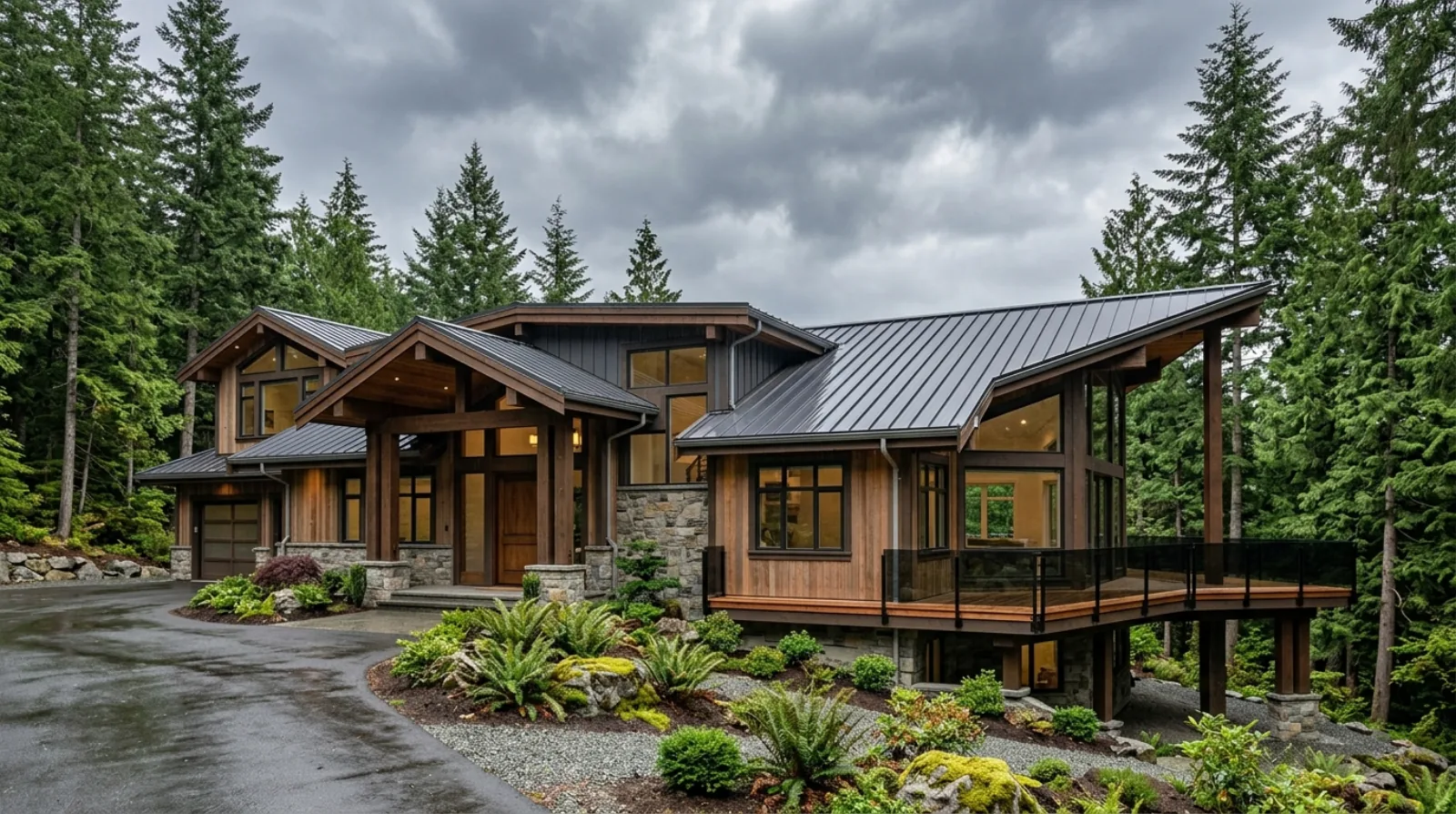
Standing-seam metal looks its best on clean, simple, modern roof forms with long uninterrupted slopes, where its crisp seam lines read as intentional and sharp. On a busy traditional roof, metal gets expensive and fussy fast.
So the roof form itself often pushes the answer: simple modern lines favour metal, a complex traditional roof with many planes often favours shingle.
How we actually choose
Here is the short version of how we sort it on a real coastal build.
Lean metal when:
- The lot is shaded and moss-prone (metal stays cleaner).
- Solar is planned or likely (cleaner mounting, matched lifespan).
- The roof form is simple and modern with long clean slopes.
- Long life with low maintenance is the priority.
Lean asphalt shingle when:
- The roof is complex, with many valleys, dormers, and changes of plane.
- You want a proven, easily repaired roof where a single damaged area can be fixed in a section.
- The architecture is traditional and shingle suits the look.
Neither is the right answer for every house. The lot's exposure, the roof's shape, and whether solar is in the plan decide it. We look at all three before we recommend one, and we detail the flashing, valleys, and drainage carefully on either roof, because good drainage is what keeps any coastal roof healthy for its full life.
Frequently asked questions
- Is a metal roof or asphalt shingle better for the BC coast?
- Both perform well when installed properly, and the right answer depends on the roof. Standing-seam metal lasts longer, sheds rain and snow cleanly, resists moss on shaded slopes, and is the better base for solar. Asphalt shingle is proven, quiet in the rain, easy to repair in sections, and handles complex roof shapes with many valleys and dormers more gracefully. Icon Projects weighs roof shape, exposure, shade, and whether solar is planned before recommending one over the other, rather than applying a single rule to every home.
- Do metal roofs get moss like shingles on the coast?
- Far less. Moss needs a rough, water-holding surface to take hold, and it loves the shaded, damp north slopes common on our tree-lined lots. A smooth metal roof gives moss much less to grab, so it stays cleaner with less intervention. Asphalt shingle, with its granular surface, holds moisture and lets moss creep under the edges, which is why shaded shingle roofs here often need periodic cleaning. Icon Projects still details flashing and slopes carefully on both, because good drainage is what keeps any coastal roof healthy.
- Are metal roofs noisy in the rain?
- Not in a properly built house. The drumming people remember comes from bare metal over open framing, like an old shed or barn. On a modern home the metal sits over solid sheathing with underlayment, and the attic insulation and assembly below dampen the sound so it is close to a shingle roof inside. Icon Projects builds the full assembly, sheathing, underlayment, insulation, and ceiling, so rain noise is a non-issue whichever roof you choose.
- Which roof material handles a complex roof shape better?
- Asphalt shingle handles complex roofs, with many valleys, hips, dormers, and changes of plane, more gracefully and economically than metal, because the material is small pieces that follow the form. Standing-seam metal is possible on a cut-up roof, but it demands much more skilled labour at every valley and transition to stay watertight, and it looks its best instead on clean, simple, modern roof forms with long uninterrupted slopes.
- How does snow shedding differ between a metal roof and an asphalt shingle roof?
- A metal roof's smooth surface lets snow slide off rather than build up, which reduces roof load but can release snow in a sudden slide, so Icon Projects details snow guards over an entry, walkway, or parking spot on a metal roof. Asphalt shingle holds snow longer and releases it slowly as it melts, avoiding the sudden-slide risk but keeping more load on the roof for longer, which mainly matters on a snowier elevated Lower Mainland lot.
- Why does moss shorten the life of an asphalt shingle roof?
- Asphalt shingle has a granular surface that holds moisture, and moss creeps under the shingle edges, lifts them, and holds water against the roof, which shortens its life. This is why shaded shingle roofs on tree-covered Burnaby lots often need periodic cleaning. A smooth metal roof gives moss far less surface to grab, so it stays cleaner with much less maintenance on the same shaded slope.
- What determines a coastal roof's actual lifespan more than the material itself?
- Slope, exposure, shade, installation quality, and maintenance all affect real lifespan as much as the choice between metal and shingle, which is why Icon Projects avoids putting exact year numbers on either material. What holds true directionally is that standing-seam metal is the longer-life choice with lower maintenance, and asphalt shingle is the shorter replacement-cycle choice, especially on a damp, shaded north-facing slope.
- How does a standing-seam metal roof shed rain differently than asphalt shingle?
- A standing-seam metal roof has raised, interlocking seams running down the slope with fasteners hidden underneath, which means fewer holes through the roof surface and fewer places for water to find a way in. Asphalt shingle sheds rain through many overlapping pieces instead, so its performance depends more heavily on getting the detailing right at valleys, edges, and penetrations. On the coast's long wet season, Icon Projects treats metal's cleaner shedding as a genuine strength, though a well-detailed shingle roof still performs reliably.