
Renovations · Burnaby
Home Renovations in Burnaby
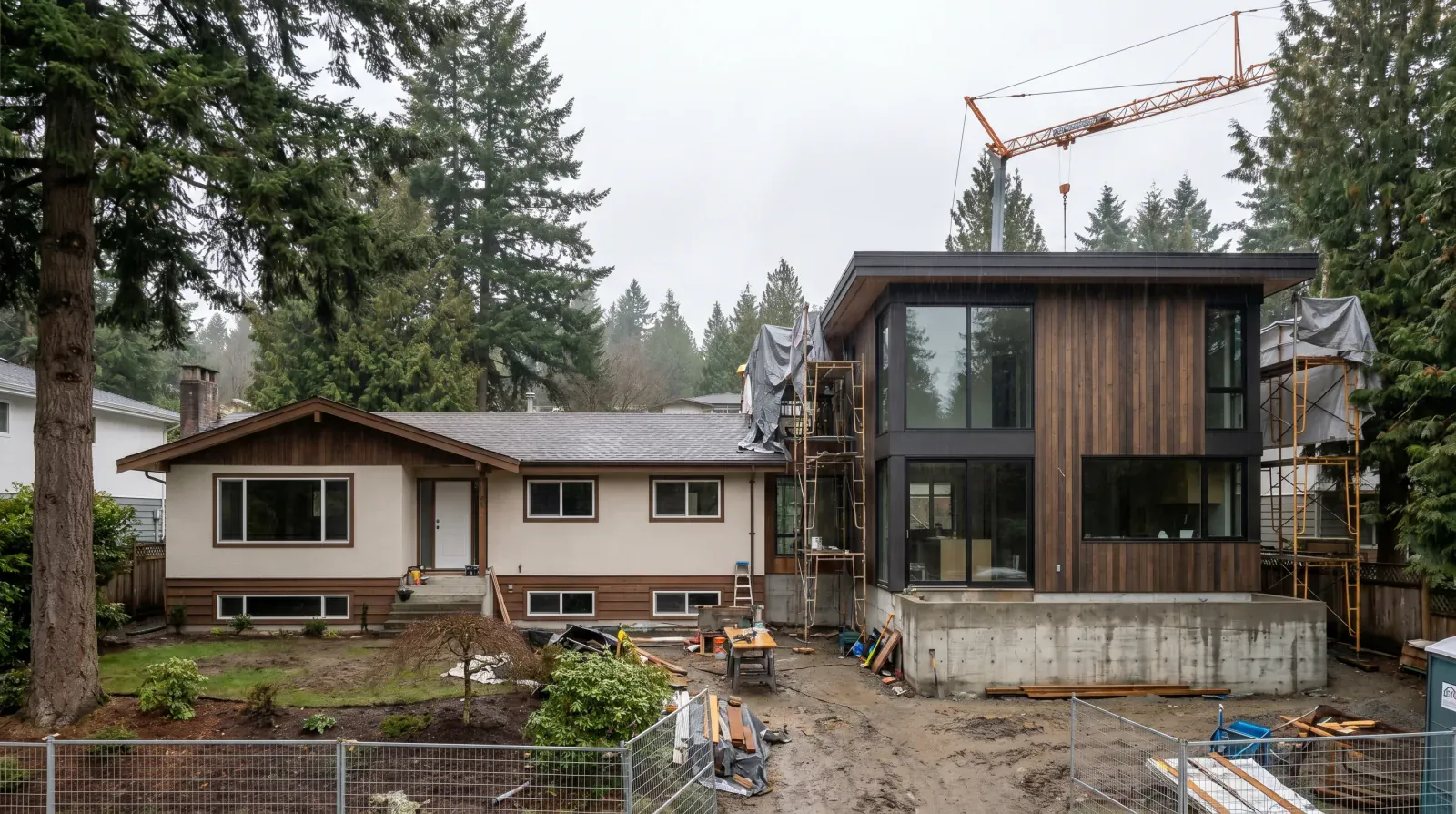
Most of the homes we are asked to renovate in Burnaby were built between the 1950s and the late 1970s. They tend to have solid framing and generous lots, and almost everything else inside them is due. Our job is to work out how much of the existing house is worth keeping, and to say so plainly before anyone spends money on drawings.
Last reviewed August 2026
At a glance
How we work here.
- Whole-home renovations, additions and second-storey work across Burnaby
- An honest read on whether your house should be renovated or rebuilt, before design starts
- We plan around the Burnaby tree bylaw and the city's permit process from the first site visit
- Hazardous materials handled the way WorkSafeBC requires on older homes, not worked around
Our approach
Renovating in Burnaby.
What we usually find in a Burnaby home from the 1950s to 1970s
Burnaby's single-family streets filled in over about three decades after the war, and the houses share a family resemblance. Post-and-beam or conventional framing that is still doing its job. Full basements, often with low headroom. Single-pane windows. Electrical panels sized for a household that did not own a heat pump, an induction range or two cars that plug in.
That combination is why so many Burnaby renovations turn into bigger projects than the owner first pictured. The finishes are the visible problem, but the envelope, the electrical service and the mechanical system are the expensive one. We open up a small area early, look at the framing, the insulation and the panel, and give you a scope based on what is actually there rather than on what the listing said.
- Envelope: insulation levels, air sealing, windows and any past water damage at the rim joist
- Electrical: panel capacity and whether the service to the house needs upgrading at all
- Mechanical: whether the existing ducting can carry a heat pump or needs replacing
- Structure: what can be removed to open a plan, and what is carrying load
Where a renovation stops and a rebuild starts, and why the line matters
This is the single most useful thing to understand before you renovate an older Burnaby home, and most homeowners have never been told it.
Under BC's Homeowner Protection Act, a "new home" is not only a house built on bare ground. The definition in section 1 also covers a home that is, or is being, substantially reconstructed. Section 22(1) says a person must not build a new home unless it is registered for home warranty insurance. So a project large enough to count as substantial reconstruction has to carry the 2-5-10 warranty, the same as a brand-new house.
A normal renovation of an existing home does not carry that warranty. Neither do additions or renovations done after you have already moved in. If your project is drifting toward the substantial reconstruction line, that changes who can legally do the work, what it has to be registered for, and what protection you end up with. It is much cheaper to find this out during feasibility than halfway through demolition.
We look at that question early and tell you which side of the line your project sits on. Sometimes the honest answer is that you should stop renovating and rebuild instead. We would rather say that in the first meeting.
Additions and second-storey work
Adding floor area is the most common request we get in Burnaby, because the lots are often big enough to support it and the existing houses are often smaller than a family needs now.
Two things decide whether it is realistic. The first is whether the existing foundation and framing can carry another floor, which is a structural question and needs an engineer, not an opinion. The second is what the zoning allows on your specific lot in terms of floor area, height and setbacks. On Burnaby's sloped lots, height is measured in a way that can surprise people, and it is worth checking before you fall in love with a plan.
Where a second storey does not work, a ground-level addition often does, and on some lots the better answer is neither. We run that comparison before design fees start.
Asbestos and hazardous materials on older Burnaby homes
Asbestos was widely used in BC building materials until the early 1990s, which covers essentially the whole era of Burnaby's single-family stock. It turns up in places people do not expect, including floor tile, sheet flooring backing, drywall joint compound, textured ceilings, pipe insulation and roofing.
WorkSafeBC's rules here are not optional and they are not a formality. If asbestos is suspected, work stops and a qualified professional completes a survey. Since January 1 2024, asbestos abatement contractors must be licensed to operate in British Columbia and the people doing the work must hold WorkSafeBC certification. A notice of project has to be submitted to WorkSafeBC for all asbestos work.
We build the survey into the schedule at the start instead of discovering the problem the week demolition begins. A renovator who tells you not to worry about it on a 1965 house is telling you something useful about how they run their sites.
Permits, protected trees and the city's process
Burnaby reviews carefully, and renovation work is not exempt from that. As of January 2026, building-permit applications are filed through the city's online My Permits Portal, and paper applications are no longer accepted.
Trees matter more than most owners expect. On a property subject to a development application, any tree 20 cm in diameter or larger counts as a Protected Tree under the Burnaby tree bylaw. Removing one requires a tree-cutting permit, a tree management plan prepared by a certified arborist, and replacement planting. On an addition, the position of two or three protected trees can decide where the new footprint can go, so we get an arborist to walk the lot before anyone draws it.
We map the permit steps into your schedule at the start and keep you told about where the application actually sits. We do not promise approval dates that are not ours to give.
What the Energy Step Code does and does not require on a renovation
Burnaby requires Step 3 of the BC Energy Step Code plus EL-4 of the Zero Carbon Step Code for new Part 9 homes. Owners often assume the same targets automatically apply to a renovation of an existing house. In general they do not, because those requirements are written for new construction.
That does not mean energy performance stops mattering. When the walls are already open, improving insulation, air sealing and window performance costs far less than doing it as a separate job later, and it is the difference between a house that is quiet and even in temperature and one that is not. We will show you which envelope upgrades are worth doing while access is free, and which ones are not worth the disruption.
If your project crosses into substantial reconstruction, the code picture changes. That is another reason to settle that question early.
Common Questions
Before you start in Burnaby.
Should I renovate my Burnaby home or tear it down and rebuild?+
It depends on the foundation, the framing and how much of the layout you want to change. If the foundation is sound, the basement has usable headroom and you are keeping most of the plan, a renovation usually wins. Once you are moving most of the walls, replacing the mechanical and electrical systems and reworking the envelope, the cost gap narrows and a rebuild often gives you a better house. There is also a legal line: a project that counts as substantial reconstruction under BC's Homeowner Protection Act is treated as a new home and has to be registered for 2-5-10 warranty coverage. We work out which side of that line you are on before design starts.
Does the 2-5-10 home warranty cover my renovation?+
Not for an ordinary renovation of an existing home, and not for additions or renovations carried out after you have moved in. The mandatory 2-5-10 warranty under the Homeowner Protection Act applies to new homes. The definition of a new home does include a home that is being substantially reconstructed, so a large enough project does have to be registered. Ask any builder you are interviewing which category your specific project falls into, and be careful with anyone who cannot answer.
Do I need a permit to renovate in Burnaby?+
Structural changes, additions, changes to plumbing or electrical, and most work that alters the building envelope need a building permit. Since January 2026, Burnaby takes building-permit applications only through its online My Permits Portal. Cosmetic work such as paint, flooring or replacing cabinets in the same layout generally does not. We confirm the permit scope for your project during feasibility rather than guessing.
Do I need to worry about asbestos in a Burnaby home?+
If your home was built before the early 1990s, yes, and most of Burnaby's single-family stock is older than that. Asbestos can be present in flooring, drywall compound, textured ceilings, pipe insulation and roofing. WorkSafeBC requires a survey by a qualified professional where asbestos is suspected, and since January 1 2024 abatement contractors must be licensed in BC with certified workers. A notice of project must be submitted to WorkSafeBC for all asbestos work. We schedule the survey up front so it does not stop the job later.
Can I add a second storey to my Burnaby house?+
Sometimes. It comes down to whether the existing foundation and framing can carry the load, which an engineer has to confirm, and what your lot's zoning allows for floor area, height and setbacks. On sloped Burnaby lots the height calculation is the part that catches people out. We check both before you commit to a design.
Will a renovation have to meet the BC Energy Step Code?+
Burnaby's Step 3 plus Zero Carbon EL-4 requirements are written for new Part 9 homes, so a typical renovation of an existing house is not held to them. We still recommend improving insulation, air sealing and windows while the walls are open, because that access is the cheapest it will ever be. If the project grows into substantial reconstruction, the code position changes and we will tell you.
Keep reading
Related pages.
- Our whole-home renovation service
- Additions and second-storey work
- Custom home builder in Burnaby
- Guide: renovate, add, or rebuild
- Renovate, add, or rebuild: reading the bones of an older home
- The Burnaby tree bylaw and your project
- How height is measured on Burnaby slope lots
- BC's 2-5-10 home warranty explained
Begin
Talk through your Burnaby renovation.
Tell us about the building and what you want to change. We will tell you what is worth keeping, what is not, and whether a renovation is the right call at all.