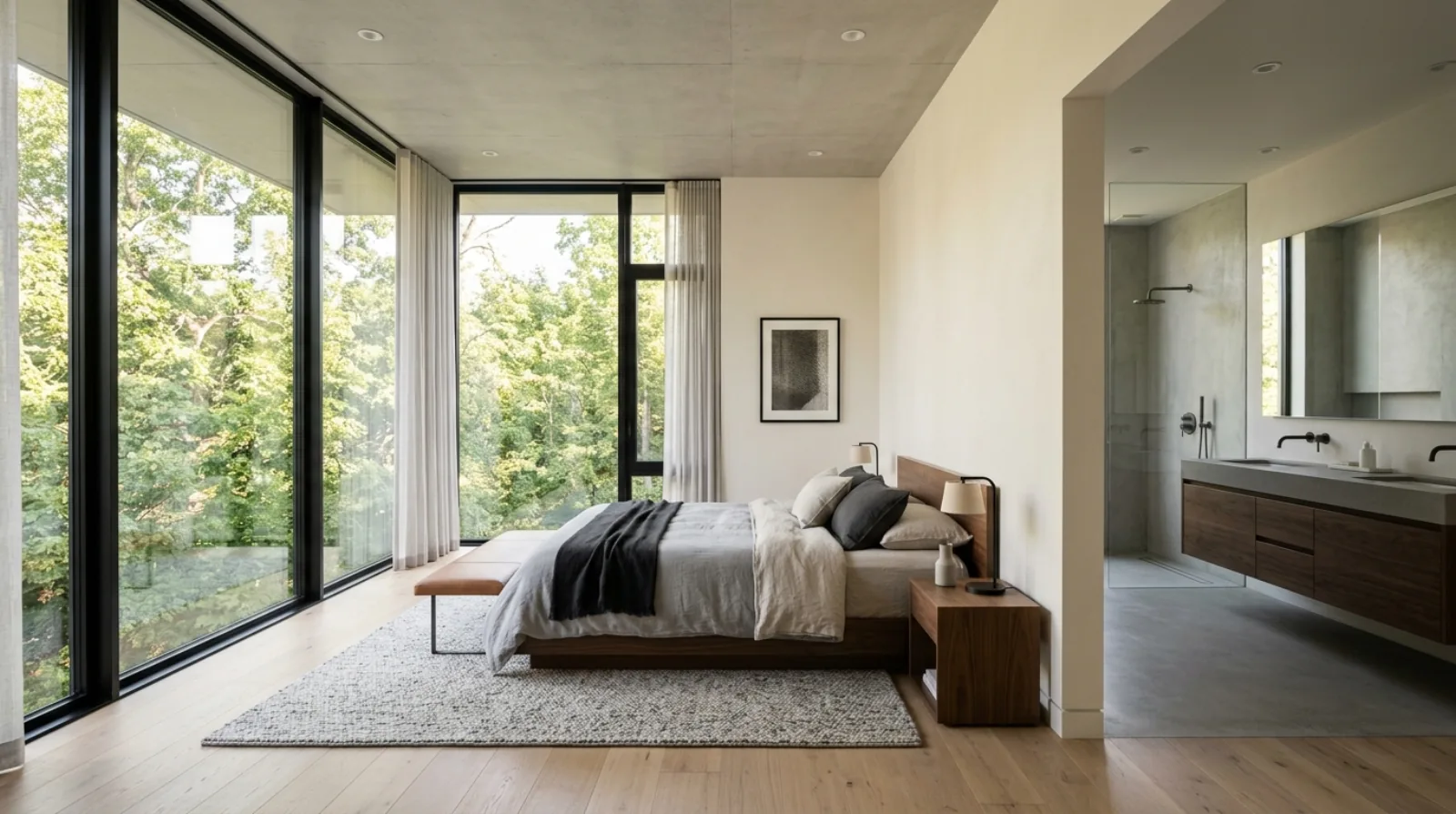
The primary suite is the one room in a custom home you live in every single day, and it is the room people get wrong most often. Here is a builder's take on what actually makes a primary suite good to live in, where it sits in the plan, how it stays quiet, how it gets morning light without baking in the afternoon, and why the walk-in closet is the most under-planned room in the house.
Clients will spend three meetings on the kitchen island and thirty seconds on the primary suite. I understand why, the kitchen is where you entertain, it's the photo everyone wants, it's the room guests see. But the primary suite is the room you actually live in. It's where you start and end every day, where you're tired and unguarded and not performing for anyone. Get it wrong and you feel it twice a day for as long as you own the house.
And it gets designed wrong constantly. Not because anyone is careless, but because the decisions that make a primary suite good are quiet ones. They don't show up in a render. A bedroom that's dead silent at 6 a.m. looks identical on paper to one that shares a wall with the laundry room. A closet you can actually use looks, on a floor plan, like the same rectangle as a closet that fights you every morning. The difference is in choices made before framing, placement, sound, light, storage, the order the water runs, and those are exactly the choices that get rushed.
So here's how I think about a primary suite when we're laying out a custom home in Burnaby, the Tri-Cities, or anywhere in the Lower Mainland. None of this is about spending more. Most of it is about spending attention at the right moment.
Where the suite sits in the plan
The first decision is the biggest, and it's almost always made for the wrong reasons. People put the primary suite wherever the view is best or wherever there's leftover square footage. I'd start somewhere else: where is it quiet, and who do you want to be near?
On a two-storey home, the default is to stack all the bedrooms upstairs. That's fine for a young family who wants the kids within earshot. But it puts your bedroom one thin wall away from a teenager's room, and a teenager's life runs on a different clock than yours. If acoustic separation matters to you, and at some point it will, you want the primary suite at the opposite end of the upper floor from the other bedrooms, ideally with a hallway, a bathroom, or a closet acting as a buffer between them. Sound doesn't travel through dead space. Use the dead space on purpose.
The other live question in Burnaby right now is the main-floor primary. More of my clients are asking for it, and not only the ones thinking about getting older. A main-floor suite means you can live on one level, bedroom, bathroom, kitchen, laundry all on grade, and treat the upstairs or the basement as space for kids, guests, or a future that hasn't arrived yet. On the hillside lots that define Capitol Hill, Burnaby Heights, and the Government Road area, the grade sometimes hands you a natural way to do this: the main floor opens to a private garden at the back while the street side reads as a normal two-storey. If you're building somewhere you intend to stay for decades, the main-floor primary is worth pricing even if you don't think you need it yet. (I keep the actual aging-in-place details, grab bars, blocking, roll-in clearances, in a separate conversation; this is about whether the room is on the right floor to begin with.)
One more thing about placement: keep the suite away from the mechanical room, the laundry, and the garage wall. A heat pump cycling on at night, a washer hitting spin cycle, a car door at 11 p.m., none of those belong against a bedroom. It costs nothing to notice this on the plan and a fortune to fix once the ducts are run.
Quiet is a build decision, not a luxury
People assume a quiet bedroom is about thick walls and expensive materials. It isn't, really. It's about three cheap things done deliberately.
First, the wall behind the bed. Standard interior walls in a house are built for privacy, not silence, a single layer of drywall on each side of an empty stud cavity passes sound straight through. If you put insulation in that cavity, use a solid-core door instead of a hollow one, and seal the gaps where sound leaks (under the door, around outlets), you get a bedroom that's genuinely calm. The building code already sets a high bar for the walls between separate homes: the National Building Code requires assemblies between dwelling units to hit a Sound Transmission Class of 50, a lab-tested rating where loud speech next door is barely audible (Construction Canada, on the NBC's STC requirements). Inside a single family home, nothing forces you to build to that standard between your own rooms, but you can ask for it where it matters, and the primary suite wall is exactly where it matters.
Second, the door. A hollow-core door is a drum. A solid-core door is a wall you can walk through. The upgrade is small money per door and it's the single most noticeable change most people feel when they step into a well-built bedroom.
Third, isolation from the machines. I said it above and I'll say it again because it's the one people regret: don't share a wall, floor, or ceiling between the primary suite and the laundry, the mechanical room, or a powder room with a noisy fan. If the layout forces a shared wall, that's the wall to insulate and to keep plumbing out of. Water moving through pipes inside a bedroom wall is a sound you can't unhear once you've noticed it.
Light that wakes you up, and doesn't cook you
The best primary bedrooms I've built get soft light in the morning and stay cool in the afternoon. That's not luck. It's orientation.
East-facing glass gives you gentle morning light, the kind that makes a bedroom feel alive when you wake up, without the harsh, heat-loaded afternoon sun that comes off the west. So if you have any choice in where the bedroom window lands, aim the main glazing roughly east, or southeast. Save the big west-facing windows for the living spaces you occupy in the evening, where that golden late light is an asset instead of a sleep problem and an air-conditioning bill.
This matters more than it used to. Lower Mainland summers run hotter than the housing stock was built for, and a primary bedroom with a wall of unshaded west or south glass becomes an oven by mid-afternoon, exactly when you don't want it, and exactly the heat that's still trapped in the room at bedtime. The fixes are all design-stage: orient the bedroom glass east, size the west and south windows with restraint, and let a roof overhang or a deck above shade the summer sun while still letting the lower winter sun in. (I've gone deep on getting daylight right elsewhere; here the point is narrower, in a bedroom, you want morning, not afternoon.)
Privacy plays into the same window. On a tight Burnaby lot, the neighbour's house is close, and a bedroom window aimed straight at their kitchen is a window you'll keep blinds-down forever, which defeats the purpose. The move is to place the glass to catch sky and treetops rather than the neighbour's wall, higher on the wall, or angled toward a screen of trees, or set above eye line. A bedroom that's bright and private at the same time is almost always a window that was positioned with both jobs in mind.
And every bedroom in the house, primary included, needs a window that opens wide enough to climb out of in a fire. That's not optional. Under Part 9 of the BC Building Code, every bedroom requires at least one outside window or exterior door that opens from the inside without keys or tools, giving an unobstructed opening of not less than 0.35 square metres with no dimension under 380 millimetres (BC Building Code Section 9.9.10, as summarised by The Great Egress Co.; the code itself is published by the Province at gov.bc.ca BC Codes). It's an easy requirement to meet on a main floor and a real design constraint in a basement, where it usually means a proper egress window in a window well. Worth knowing before you fall in love with a bedroom layout that can't legally have a bed in it.
The ensuite: plan it around where the water runs
An ensuite is a small room doing a lot of jobs at once, and the difference between a good one and a frustrating one is almost entirely layout.
Start with the wet zones. The shower and the bathtub want to be grouped near the plumbing, ideally backing onto the wall where the main stack runs and, on an upper floor, stacked over the plumbing below. Plan that alignment early and the rough-in is clean and cheap. Ignore it and you're snaking pipes across joist bays and dropping bulkheads in the ceiling below to hide them.
A few choices I push clients toward, because they're the ones people thank me for later:
- A double vanity, if the room can hold one. Two people getting ready at the same time on a weekday morning is the single most common ensuite pinch point, and a second sink solves it for the life of the house.
- A separate water closet. Putting the toilet in its own small compartment with a door is the cheapest privacy upgrade in the house and the one shared couples appreciate most.
- A curbless shower. A shower with no lip to step over reads as clean and modern, drains better when it's built right, and quietly future-proofs the room, no step to trip on, no barrier if mobility ever changes. It has to be detailed properly: the floor slope, the linear drain, the waterproofing all have to be designed in, not improvised on site. Done right, it's one of those details that looks effortless and is anything but.
- Real ventilation. A bathroom that doesn't vent properly grows mould and rots the finishes you paid for. The BC Building Code requires an exhaust fan in every bathroom and water-closet room (or service by the home's principal ventilation system) under Section 9.32, Ventilation (BC Building Code, Section 9.32, via the Province's BC Codes page). Meet the minimum and move on, or, my preference in a tight, well-sealed modern home, fold the ensuite into a whole-house heat-recovery ventilation system so the moisture leaves the building continuously instead of in noisy bursts.
The thread running through all of it: an ensuite is a plumbing and ventilation problem wearing a tile finish. Solve the rough-in and the airflow first, and the beautiful version of the room comes easily.
The walk-in closet is the most under-planned room in the house
I'll say it plainly: the closet is where I see the most regret, because it's the room people treat as an afterthought and then use every single day.
Here's the pattern. The bedroom gets generous square footage, the ensuite gets the nice finishes, and the closet gets whatever rectangle is left over, often a deep, awkward space with a single rod and a shelf, or a walk-in so narrow two people can't both be in it. Then the family moves in, and within a month the closet is overflowing while a perfectly good four square metres of it does nothing because nobody planned the inside.
A closet that works is designed like a small room, not measured like a leftover. That means thinking in advance about the mix of what's going in it, how much hanging space versus folded versus shoes versus long items like coats and dresses, and laying out the rods, drawers, and shelves to match a real wardrobe instead of a generic one. It means leaving enough clear floor in the middle to stand and turn and actually get dressed. It means good light, because a closet you can't see into is a closet you don't use. And if two people share it, it means dividing the space so you're not constantly in each other's way at 7 a.m.
The mistake to avoid is the opposite one, too: a cavernous walk-in with a single rod around the perimeter wastes as much space as a cramped one, just differently. Volume isn't the point. Fit is the point. I'd rather build a smaller closet laid out around how you actually dress than a bigger one that's mostly empty air.
This is the decision that costs almost nothing to get right on the drawings and is genuinely painful to fix afterward, which is exactly why it belongs in the same category as the other features I tell clients are worth real attention, see the custom-home features worth investing in for where I'd put the budget and where I wouldn't.
Comfort you don't have to think about
A primary suite should be the most comfortable room in the house, temperature-wise, and the way you get there is zoning.
A single thermostat for the whole house always shortchanges some room, and it's usually a bedroom, too warm because it's catching afternoon sun the living room shed hours ago, or too cold because it's on the far end of the duct run. A heat-pump system that lets the primary suite run on its own zone fixes this. You set the bedroom to the temperature you actually sleep at, independent of what the rest of the house is doing, and the system holds it. In a climate where the same week can need heating overnight and cooling by afternoon, a heat pump does both from one piece of equipment, quietly. The quiet part matters in a bedroom specifically, pick equipment and locate the indoor unit so it isn't a hum you fall asleep to.
The point of all this, the zone, the east window, the insulated wall, the planned closet, is that you stop noticing the room. A well-built primary suite disappears. You're not fighting the temperature, the light, the noise, or the storage. You just live there.
The details that earn their keep over years
The finishes in a primary suite take more daily contact than almost anywhere else in the house. Bare feet on the floor every morning. A hand on the same closet pull and the same door a few thousand times a year. Steam against the ensuite surfaces twice a day. So this is a room where the durability of materials shows up fast, for better or worse.
I'd rather a client spend on a floor that wears in instead of wearing out, on solid hardware that still feels right in a decade, on tile and stone and surfaces that take humidity and handling without looking tired. The cheap version of any of these looks identical on day one and visibly worse on day five hundred. In a room you're in this much, that gap is the whole game. I've written separately about the materials that actually age beautifully, and the primary suite is the first place I'd apply that thinking, it's the room that rewards it most.
If you're planning a custom home in Burnaby, Vancouver, North Vancouver, Coquitlam, or New Westminster and you want the primary suite designed as deliberately as the kitchen, that's exactly the thinking we bring to our custom-home work. Bring us the plan before it's locked, the cheapest time to fix a bedroom is while it's still lines on paper. For homeowners upgrading an existing primary bathroom rather than building from scratch, our bathroom renovation service applies the same thinking to the space you already have. If the suite is part of a bigger gut renovation, opening up the main floor, replacing the mechanical, reconfiguring circulation, our full home renovation service covers how we approach that larger scope.
Frequently asked questions
- Should the primary suite be on the main floor or upstairs?
- It depends on how you plan to live in the house and for how long. Upstairs is the conventional choice and works well for families who want bedrooms grouped together. A main-floor primary suite is worth pricing if you intend to stay in the home for decades, want the option to live entirely on one level, or value being able to treat the upper floor and basement as flexible space for kids, guests, or the future. On Burnaby's hillside lots, the grade sometimes makes a main-floor suite that opens to a private back garden especially easy to do. Neither is automatically right, it's a placement decision to make on purpose, early.
- Does every bedroom need an egress window in BC?
- Yes. Under Part 9 of the BC Building Code, every bedroom must have at least one outside window or exterior door that opens from the inside without keys or tools, providing an unobstructed opening of not less than 0.35 square metres with no single dimension under 380 millimetres. The requirement exists so a person can escape a fire without using the room's normal exit and a firefighter can get in. It's straightforward to meet on an upper or main floor and a real design constraint in a basement, where it usually means a properly sized egress window in a window well.
- How do you soundproof a primary bedroom?
- Three things, all decided before framing and none of them expensive: insulate the wall cavities around the bedroom (an empty stud wall passes sound straight through), use a solid-core door instead of a hollow one, and isolate the suite from the machines, don't share a wall, floor, or ceiling with the laundry, mechanical room, or a noisy bathroom fan, and keep plumbing out of the wall behind the bed. The building code requires walls between separate homes to reach a Sound Transmission Class of 50; you can ask your builder to apply that standard to the primary suite wall even though nothing forces it inside a single-family home.
- Which direction should a primary bedroom window face?
- Roughly east or southeast, if you have a choice. East-facing glass gives soft morning light without the harsh, heat-loaded afternoon sun that comes off the west. Save large west-facing windows for living spaces you use in the evening. In a Lower Mainland summer, a bedroom with a wall of unshaded west or south glass overheats by mid-afternoon and stays warm into the night, so size those windows with restraint and use overhangs or a deck above for shade.
- What makes a good walk-in closet?
- Planning the inside, not just the square footage. A closet works when it's laid out around the actual wardrobe going into it, the right mix of hanging, folded, shoe, and long-item storage, with enough clear floor in the middle to stand and turn, good light so you can see, and a sensible division of space if two people share it. A big closet with a single perimeter rod wastes as much space as a cramped one. Fit matters more than volume, and getting it right costs almost nothing on the drawings while being painful to fix afterward.
- Is a curbless shower a good idea in a primary ensuite?
- Yes, when it's detailed properly. A curbless shower, no lip to step over, looks clean and modern, drains well when the floor slope and linear drain are designed in, and quietly future-proofs the room by removing a step to trip on or a barrier if mobility ever changes. The catch is that it has to be planned and waterproofed correctly during construction; it's not something to improvise on site. Built right, it's one of the details that looks effortless and is among the more demanding to execute well.
- Does a bathroom need an exhaust fan in BC?
- Yes. The BC Building Code, under Section 9.32 on ventilation, requires an exhaust fan in every bathroom and water-closet room unless that room is served by the home's principal ventilation system. Proper ventilation isn't a nice-to-have, without it, a bathroom grows mould and rots the finishes you paid for. In a tight, well-sealed modern home, folding the ensuite into a whole-house heat-recovery ventilation system removes moisture continuously rather than in noisy bursts, which is generally my preference over a standalone fan.
- How do you keep a primary bedroom at a comfortable temperature?
- Put it on its own heating and cooling zone. A single thermostat for the whole house almost always shortchanges a bedroom, too warm from afternoon sun the living room shed hours ago, or too cold at the far end of a duct run. A heat-pump system that lets the primary suite run independently means you set the bedroom to the temperature you actually sleep at, and it holds there regardless of the rest of the house. A heat pump also handles both heating and cooling from one quiet piece of equipment, which matters in a climate where the same week can need both.