Process
How to Choose a Custom Home Builder in Burnaby and Across BC
The Lower Mainland has hundreds of active residential builders. A much smaller number are excellent. Here's how to read the difference, with the BC regulatory checks every Burnaby owner should run before signing.
How do you choose a custom home builder in BC?
To choose a custom home builder in BC, verify their BC Housing licence and 2-5-10 warranty coverage, check for CHBA professional designations, walk three of their finished homes at year three or later, and ask directly about trade relationships, budget practices, and realistic timelines. Independent verification takes about an hour and is the most important step.
The Lower Mainland has hundreds of active residential builders. Plenty of them are competent. A much smaller number are excellent. The signals that separate the groups aren't subtle. They're just not what most owners look for first.
We work primarily in Burnaby with custom builds across Vancouver, Coquitlam, North Vancouver, Surrey, and the Fraser Valley. The framework below is what we'd use if we were on the other side of the table, hiring a builder for a custom home of our own.
Start with the regulatory floor
Under BC's Homeowner Protection Act, every residential builder building a new home in BC has to be licensed by BC Housing and every new home has to carry mandatory 2-5-10 home warranty insurance. Two years on materials and labour. Five years on the building envelope, including water penetration. Ten years on structural defects in load-bearing parts of the home.
That's the floor. If a builder can't immediately confirm:
- Their active residential builder licence number
- Which warranty insurance provider has accepted the project
- That the warranty paperwork can be produced for verification
…the conversation should end there. None of those is optional. None of them is something a builder can finesse around. The licence list and the warranty providers are public registries; an owner can verify everything independently in under an hour.
The single biggest red flag
A builder who can't or won't produce their licence and warranty information on a first call is signalling something the rest of the interview cannot recover. We've never met a competent BC builder who hesitated on this question. The hesitation itself is the answer.
Look for designations, then look past them
The Master Residential Builder designation through CHBA BC is the strongest professional accreditation a residential builder in Canada can hold. To earn it, a builder needs at least 10 years in residential construction (5 of those at management level), an 80% pass on CHBA BC's required courses, and three reference letters from clients, suppliers, or subtrades.
It's a meaningful baseline. It tells you the builder has been around long enough to develop systems, has invested in continuing education, and has been vouched for by people who've worked with them on actual projects. Two MRBs can still deliver very different experiences, so treat the designation as a filter, not the answer.
The CHBA BC list of certified designation holders is public. An owner can verify any claimed credential without taking the builder's word for it.
What MRB does not tell you
The designation says nothing about:
- Fit for the specific project. An excellent multifamily builder may not be the right fit for a custom home. An excellent custom builder may not be the right fit for a hillside Capitol Hill build with real grade and tree retention.
- The personal chemistry between owner and builder. A custom build is a 24-month relationship. The relational quality matters as much as the credential.
- Project size sweet spot. Some builders thrive on $2M projects and stretch on $6M projects. Others operate the other way. The credential doesn't reveal this; the project portfolio does.
Walk three of their finished homes
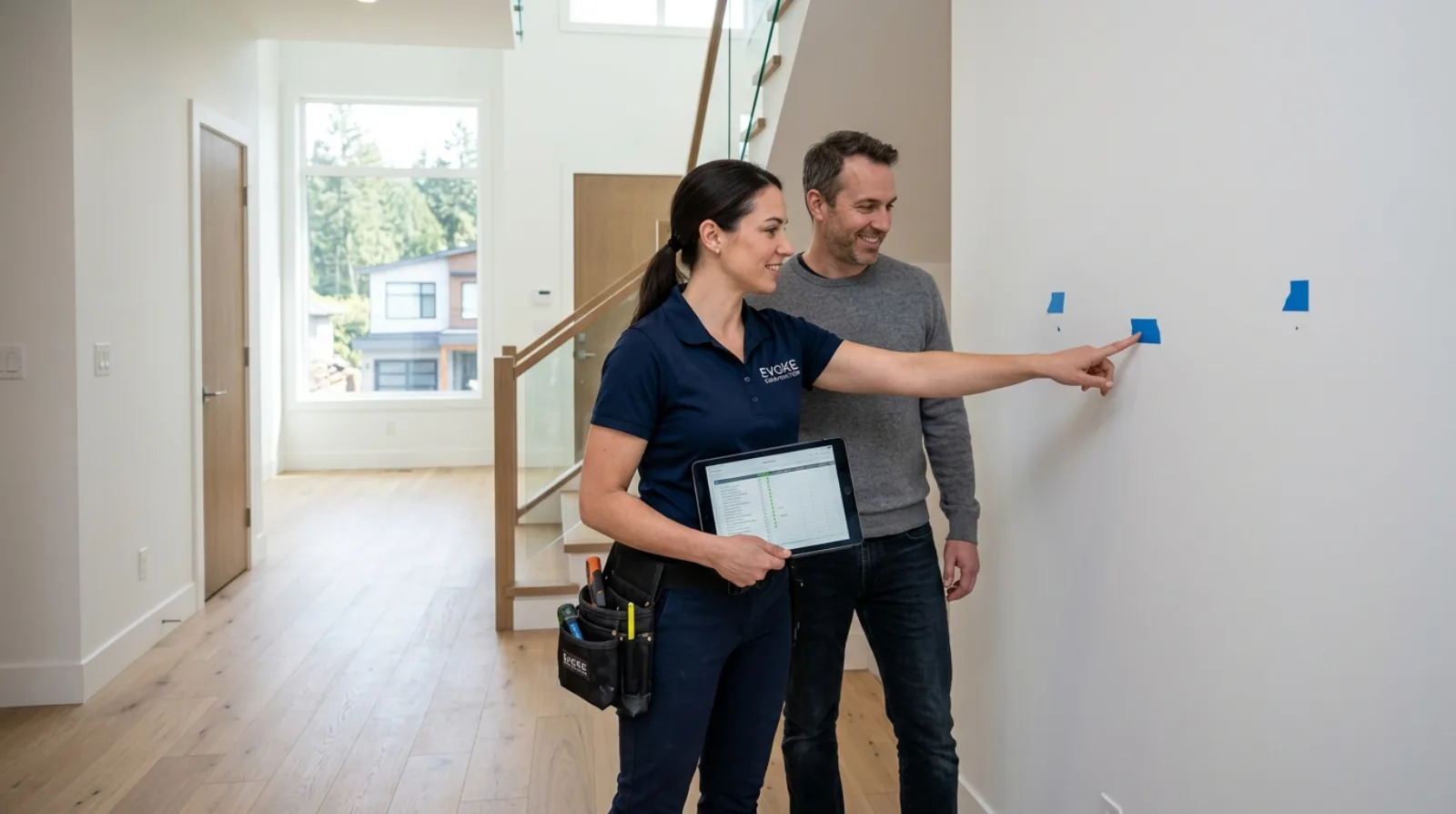
Photos are marketing. Walking a finished home is data. Pay attention to the things that take time to develop. How the doors close. How the trim joints have aged. Whether the cabinetry still looks crisp three years on. The boring details are the honest ones.
What we'd specifically look at on a walkthrough:
- Door closures. A door that hangs out of plumb, sticks, or rattles in its frame is showing structural settlement, framing imprecision, or carpentry shortcuts. None of those are visible in photos.
- Trim joints at year three. Mitered corners on baseboards, casing returns, picture rails. If the joints have opened up, the carpenter cut the lumber when it was wet, or used inferior material.
- Floor wear patterns. Where does the floor look its age first? In a properly installed solid hardwood with oil finish, the wear pattern is even and the patina is uniform. Bargain finishes wear in patches.
- Window operation. Open and close every operable window. The seals should still feel firm; the operating hardware should still feel solid.
- Bathroom and kitchen function at year three. These are the rooms that get used hardest. Cabinets, plumbing fixtures, finishes. Year three is the honest test of the original specification.
Ask who actually swings the hammer
Some builders run dedicated in-house crews. Others coordinate independent trades. Both can deliver excellent work. What you actually want to understand is the relationship. Has this builder worked with this framer for one project, or for fifteen years?
The trade stack on a custom home looks something like:
- Excavation and foundation
- Framing
- Mechanical, electrical, plumbing
- Insulation and drywall
- Finish carpentry and millwork
- Cabinetry
- Stone, tile, and flooring
- Painting
- Landscape
A builder with stable, long-term relationships across all nine categories is a meaningfully different operator than one who tenders each project from scratch. Tendered trades can produce excellent work, but they require a level of project management that not every builder has.
Listen to how they talk about money
Listen for whether the builder treats the project budget as a constraint to design within, or as something to figure out as the project evolves. The first is honest. The second is where projects break.
A builder who has done this well will:
- Talk in terms of the relative value of decisions, not just the dollar amounts
- Be transparent about what an allowance is versus what a fixed spec is
- Push back on a brief that doesn't fit the available budget rather than agreeing and figuring it out later
- Distinguish clearly between what they include in the contract and what falls under separate consultant scope (architectural fees, survey, geotechnical, energy advisor)
Watch for over-promising on timeline
If a builder gives you a confident timeline before they've reviewed your lot or design, that isn't confidence. It's marketing. The right answer to "how long will this take?" before they've seen the project is "let me look at it first."
A custom home in Burnaby today realistically runs 18 to 24 months from sketch to keys, accounting for:
- 4 to 7 months of design
- 4 to 9 months of permit (Burnaby is digital-only for permits submitted on or after January 1, 2026, per the City of Burnaby New Home Construction page)
- 4 to 6 weeks of pre-construction
- 12 to 16 months of construction
Anyone promising 12 months from first conversation to move-in is either skipping steps or using a different definition of "month."
Test the friction
Notice how they respond to a hard question, a late email, a decision you keep changing your mind on. A custom build will involve hundreds of those moments. The version of the builder you see during the sales process is the gentle version. We tell prospective clients to deliberately make at least one difficult ask during the interview process, push back on a quote item, ask for a revised proposal, change your mind on a key spec, to see how the builder handles it.
Choose the builder you'd be comfortable telling "I changed my mind" to in month nine. That's the relationship you're actually buying.
Icon Projects Team
Three independent verifications to run before signing
Outside the interview process itself, three pieces of due diligence we recommend on any builder you're seriously considering:
- Confirm the BC Housing licence is active. The public registry shows licence status, warranty provider, and any history of cancellations or disciplinary action. Under the Homeowner Protection Act, individuals associated with a cancelled licence cannot relicense or operate through a related corporation within five years, which makes the registry a meaningful integrity check.
- Verify CHBA BC designations independently. The CHBA BC certified designation holders list is public. If a builder claims MRB or Renovator of the Year, the registry confirms it.
- Search the Better Business Bureau and provincial complaint history. Not every complaint is fair, but the existence of patterns is worth knowing.
This independent verification takes about an hour. It's the cheapest insurance on the entire project.
What the right builder for the right project looks like
A few project-specific questions to layer on top of the general framework:
For a Burnaby Heights or Capitol Hill hillside build: has this builder handled real grade, geotechnical complexity, and tree-retention work? Hillside experience is its own discipline.
For a Burnaby Mountain area build: has this builder worked with the soil profile of the lower mountain (shallow topsoils over silty sands and gravel)? Foundation strategy matters here.
For a Vancouver or West Vancouver heritage zone: has this builder worked through heritage overlays and design panel review? The permit pathway is different.
For a Fraser Valley or Surrey build: has this builder worked with Fraser Valley soils (glacial till, peat, perched water tables in pockets), and does the team travel out comfortably? Specialised finishers from central Vancouver sometimes don't.
The first conversation should feel like
Two people on the same side of the table, looking at the same project. Not a sales call. Not a quote. An honest read on what you want, what your lot allows, and what process gets you there. If the first conversation feels like a sales call, every conversation after it will too.
The right builder for a custom home in Burnaby, Vancouver, North Vancouver, or anywhere else in Greater Vancouver is the one whose answers to the questions above hold up to independent verification, who treats your lot specifically rather than generically, and whose finished homes, at year three, year five, year ten, still feel like considered pieces of work rather than rushed ones.
Take the hour to verify. Walk the homes. Ask the hard questions. Test the friction. The right builder will welcome all of it.
Frequently asked questions
How do I verify a custom home builder's licence in BC? The BC Housing public registry at bchousing.org lists all licensed residential builders. Search by company name or licence number. The registry shows current licence status, associated warranty provider, and any history of disciplinary action. Verification takes under five minutes and is the single most important check to run before any further conversation.
What is the CHBA Master Residential Builder designation? The Master Residential Builder (MRB) designation through CHBA BC requires a minimum of 10 years in residential construction (5 at management level), an 80% pass on required CHBA BC courses, and three reference letters from clients, suppliers, or subtrades. It is the strongest professional accreditation a residential builder in Canada can hold. The CHBA BC certified designation holders list is publicly searchable to verify any claimed credential.
What questions should I ask a custom home builder before hiring? The most productive questions: Can you provide your BC Housing licence number and warranty provider right now? Walk me through three homes you completed at least three years ago, can I visit them? Who are your core trades and how long have you worked with them? How do you handle scope changes during construction? What does your pre-construction process look like before we sign a build contract? The answers to these questions separate builders who have built repeatable systems from those who are still figuring it out.
How many builders should I interview before choosing one? Interview a minimum of three. Two comparisons reveal less than three. The goal isn't to find the cheapest or the most impressive, it's to find the one whose process, communication style, and trade relationships are the best fit for your specific project. A Burnaby hillside lot with tree retention and geotech complexity is a different project than a flat infill in Surrey. The builder who is excellent for one may not be right for the other.
What are the warning signs when evaluating a custom home builder? Key red flags: inability to produce a BC Housing licence number on the first call; a fixed construction price quoted before they've reviewed the lot or design; a portfolio that looks impressive in photos but whose finished homes they're reluctant for you to visit; vague answers about who actually builds the home; and any pressure to sign before completing independent verification.
Related on the Journal
- 12 questions to ask before signing
- Pre-construction services agreement explained
- Design-build vs architect + builder in BC
- Why we refuse 'builder-grade'
- Custom home vs spec home vs pre-sale: what's actually different in BC
Part of the Builder Selection Guide: Choosing a Custom Home Builder, full guide