In Greater Vancouver, the word 'custom' gets used broadly enough to blur the real distinctions. Here's what separates a true custom home from a spec build or a pre-sale, and why the difference matters more than most buyers initially realise.
What is a custom home?
A custom home is a residence designed and built specifically for one client, on their lot, to their program and brief. Every decision, floor plan, ceiling heights, materials, mechanical systems, is made in service of how that particular family will live in that particular house on that particular site.
The distinguishing feature isn't high finishes or a large budget. It's the relationship between the client, the site, and the design. A modest-budget custom home on a Burnaby Heights lot can be more genuinely "custom" than an expensive spec build with granite countertops and designer fixtures.
In Greater Vancouver, the word "custom" gets applied broadly. A builder who will let you choose from three cabinet colours is not building a custom home in any meaningful sense, which is why we spell out exactly what's involved on our custom homes service page.
What is a spec home?
A spec home (short for speculative) is designed and built by a developer without a specific buyer in mind. The developer is speculating that a buyer will emerge, before, during, or after construction, who will pay the asking price for what was built.
Characteristics of a spec home:
- The floor plan reflects the developer's read of the market, not any specific owner's program
- Finishes are selected to photograph well and appeal to the broadest pool of buyers
- The builder's relationship is with their margin, not with your family's daily life
- You typically can't make structural or major specification changes, and often can't change finishes unless the timing aligns with the build schedule
- The home exists before the buyer does, you're choosing from what was built, not directing what gets built
Spec homes are common in new subdivisions and infill developments across the Lower Mainland. They can be excellent value, and some builders produce genuinely good spec product. But the decision-making structure is fundamentally different: the builder's incentives are not aligned with any individual client's specific needs.
What is a pre-sale?
A pre-sale is a spec home purchased before or during construction. You're buying off drawings, or from a model suite, before the building exists in the form you'll occupy.
Pre-sales offer one specific advantage: the opportunity to select finishes (usually from a curated list) and sometimes to make minor adjustments to a standard unit. In exchange, you accept significant uncertainty, the product you receive may differ from the renderings, construction timelines frequently extend, and market conditions at completion may differ from market conditions at sale.
In Greater Vancouver's strata and townhouse market, pre-sales are common for multi-family buildings. They're not the same category as a custom single-family home, but the term sometimes bleeds over in marketing materials for infill projects.
What is a semi-custom home?
A semi-custom home sits between spec and fully custom. The builder has a set of standard floor plans; the client selects from available options and chooses finishes from defined packages. Some structural modifications may be available, depending on the builder and where the project sits in the construction schedule.
Semi-custom homes are most common in production builder developments, a builder who constructs fifty or a hundred homes per year in planned subdivisions. They offer more personalisation than straight spec but far less design freedom than true custom construction.
The differences that actually matter
| Custom | Semi-Custom | Spec | Pre-Sale | |
|---|---|---|---|---|
| Floor plan | Entirely yours | From a menu | Builder's choice | Builder's choice |
| Structural decisions | Client-directed | Limited options | None | None |
| Finish selection | Open | Package tiers | None | From a list |
| Site selection | You own the lot | Developer's land | Developer's land | Developer's land |
| Cost transparency | High (PCSA + spec) | Medium | Low | Low |
| Timeline control | High once permitted | Medium | None | low |
| Relationship with builder | Direct, ongoing | Transactional | Transactional | Transactional |
What custom actually requires
Building a true custom home in Burnaby or Greater Vancouver requires:
You own (or are buying) a lot. Custom home builders don't provide land. The lot is the canvas; the custom home is the work created on it.
Time. From first consultation to occupancy, a custom home in Burnaby takes 18 to 24 months. Permitting alone runs 4 to 7 months. Anyone promising much shorter timelines without a specific reason should be asked to explain the mechanism.
Involvement. A custom home requires hundreds of decisions. That's not a burden, it's the nature of the service. If decision fatigue is a real concern, a semi-custom or pre-sale product may be a better fit, and there's no shame in that. Knowing which product category suits your appetite for involvement is useful information.
A builder you trust. The relationship between a client and a custom home builder is a long one, often two years or more. You need to understand their process, their track record, and what happens when something unexpected comes up. Which it always does.
The Burnaby context
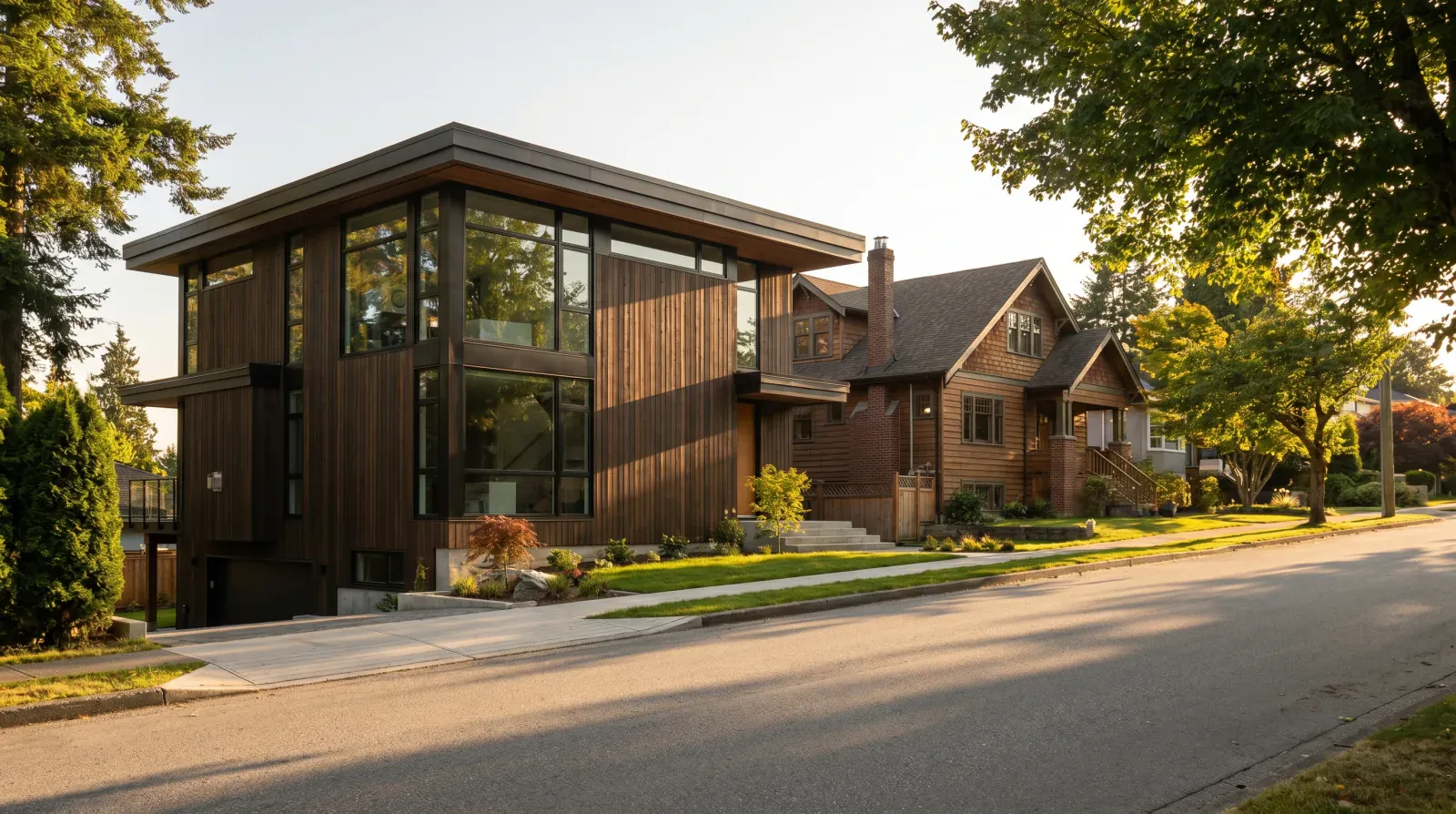
In Burnaby, most custom home projects start with a teardown. An owner buys an older post-war or mid-century home on a well-positioned lot, demolishes it, and builds to their brief on the cleared site. This is distinct from the spec-on-spec development pattern common in some other markets.
The Burnaby zoning context, Step 5 energy requirements, complex hillside lots in Capitol Hill and Burnaby Heights, the tree bylaw, the specific setback and FSR rules of the R1 zone, means that a builder who genuinely knows Burnaby provides a different service than a builder who has merely operated in the market. If your lot sits in Burnaby specifically, our lot-by-lot custom vs spec breakdown walks through Capitol Hill, Burnaby Heights, Brentwood, Big Bend and the rest of the city street by street.
How to decide: custom vs spec vs pre-sale
The right product category depends on what you're actually optimizing for. A few honest questions to work through:
Do you own land, or are you buying from a developer? A custom home requires a lot you control, the builder's canvas is your site. If you don't own land, the practical entry point is either finding a lot and engaging a custom builder, or buying spec or pre-sale on land the developer owns. These are two different markets with different brokers, timelines, and processes.
How much involvement do you want? A custom home will require hundreds of decisions over 18 to 24 months. That's not a drawback, it's the nature of the product. If you want to spend one afternoon choosing from three finish packages and then move in, a semi-custom or spec product is genuinely the better fit. Matching your appetite for involvement to the product category is more useful than any other optimization.
How important is a specific location? Spec homes in Greater Vancouver tend to cluster in active development areas. If you want a specific neighbourhood, school catchment, or street, a custom home on a teardown lot may be the only way to get there. In Burnaby Heights, Capitol Hill, or South Slope, essentially every new home is custom on a teardown lot, there's no active spec development in those neighbourhoods.
What is your timeline and life stage? Custom homes in Burnaby take 18 to 24 months from first conversation to occupancy. A pre-sale in a mid-rise building can have a completion timeline of 2 to 4 years with significant uncertainty. A completed spec home is available in weeks. If you have a hard move-in date, a lease ending, a school starting, a job relocating, a completed spec may be the only responsible option. If you have 30 months, a custom home is available to you.
Are you optimizing for this decade or the next three? Custom homes are typically specified more durably than spec homes. The materials, mechanical systems, and building envelope are selected for long-term performance rather than broad-market appeal at a given price point. Owners who plan to live in the home for twenty years tend to find the case for custom stronger than owners looking at a five-year horizon.
What the custom home process actually looks like in Greater Vancouver
For context on what engaging a custom builder in Burnaby or across the Lower Mainland involves:
-
Lot acquisition or evaluation. Either you own a lot or you identify a teardown candidate. The builder should be part of the pre-purchase conversation, they can read the lot, the zoning, and the existing structure better than almost anyone else.
-
Brief and team assembly. Architect, builder, and sometimes a landscape architect or interior designer are engaged. The brief is documented. Budget territory is established based on the program and the lot.
-
Design. Schematic design → design development → construction documents. The builder is involved throughout for constructability review.
-
Pre-construction. Pre-construction services agreement, trade tendering, schedule building, permit coordination. This is the phase that converts a good design into a buildable, contractable project.
-
Construction. Foundation through final walkthrough. 12 to 16 months in Burnaby at full specification.
-
Warranty and occupancy. BC's 2-5-10 home warranty kicks in at substantial completion.
If you're evaluating whether a custom home on a Burnaby lot makes sense for your situation, a planning call is the right starting point. We don't charge for it, and we'll give you an honest read on what's realistic.
Frequently asked questions
- What is the main difference between a custom home and a spec home in BC?
- A custom home is designed and built for one specific client on their own lot, every decision, from the floor plan to the mechanical system, serves that family's program and that site's conditions. A spec home is built by a developer without a specific buyer in mind, with decisions made to appeal to the broadest market at a given price point. The distinction is not about finish quality or budget, it is about who controls the decisions and whose life the house is designed around. Icon Projects builds custom homes only.
- How long does a custom home take compared to buying a spec home in Greater Vancouver?
- A completed spec home can be purchased and occupied in weeks. A pre-sale in a mid-rise building can take 2 to 4 years with uncertain completion dates. A custom home in Burnaby takes 18 to 24 months from first consultation to occupancy, design runs 4 to 7 months, permitting 4 to 9 months, construction 12 to 16 months. If you have a 24-month planning horizon, custom is accessible. If you need to move within six months, a completed spec or resale is the practical choice.
- Are spec homes cheaper than custom homes in BC?
- Spec homes and custom homes are not directly comparable because they involve different land ownership models. With a custom home, you own the lot and contract a builder separately for labour and materials. With a spec home, you're buying land plus construction from a single developer. The more useful question is what outcome you're paying for: custom delivers a home built to your specific program and lot. Spec delivers a home built to a developer's read of the market. Each serves a different buyer at a different life stage.
- What is a semi-custom home and is it available in Burnaby?
- A semi-custom home uses a builder's standard floor plans with client-selectable finishes and sometimes limited structural modifications. It is most common in production-builder developments in suburban markets. In Burnaby's established neighbourhoods, Capitol Hill, Burnaby Heights, Deer Lake, South Slope, the market is essentially all teardown-custom or resale. The lot characteristics, R1 zoning, and energy step code requirements make production-builder semi-custom impractical in Burnaby's core neighbourhoods.
- What is a pre-sale, and how is it different from a custom home?
- A pre-sale is a spec home purchased before or during construction, bought off drawings or a model suite before the building exists in the form the buyer will occupy. It offers the chance to select finishes from a curated list and sometimes make minor adjustments, but the buyer accepts real uncertainty, including that the finished product may differ from renderings and completion dates may shift. It is not the same category as a custom single-family home, where the owner controls the floor plan from the start.
- What does building a true custom home actually require from the owner?
- A true custom home requires owning or buying the lot, since custom builders do not provide land. It requires time, 18 to 24 months from first consultation to occupancy in Burnaby, with permitting alone running 4 to 7 months. It requires real involvement, since hundreds of decisions come with the process, and it requires a builder the owner trusts for what is often a two-year-plus relationship.
- Why is most new construction in Burnaby's core neighbourhoods custom rather than spec?
- In established Burnaby neighbourhoods like Capitol Hill, Burnaby Heights, and Deer Lake, there is essentially no active spec development. Almost every new home is a teardown-and-rebuild on a lot the owner already controls, shaped by the R1 zoning's setbacks, the tree bylaw, the Step 5 energy targets, and, on hillside lots, slope. Those site-specific conditions push toward a design built for that particular lot rather than a plan imported from flatter ground.
- Is a custom home always more expensive than a spec home in BC?
- Not necessarily, because the two are not directly comparable. A custom home means owning the lot and contracting a builder separately for labour and materials, while a spec home means buying land plus construction together from one developer. The more useful question is what outcome is being paid for: a custom home is built to one family's program and one specific lot, while a spec home is built to a developer's read of the broader market.