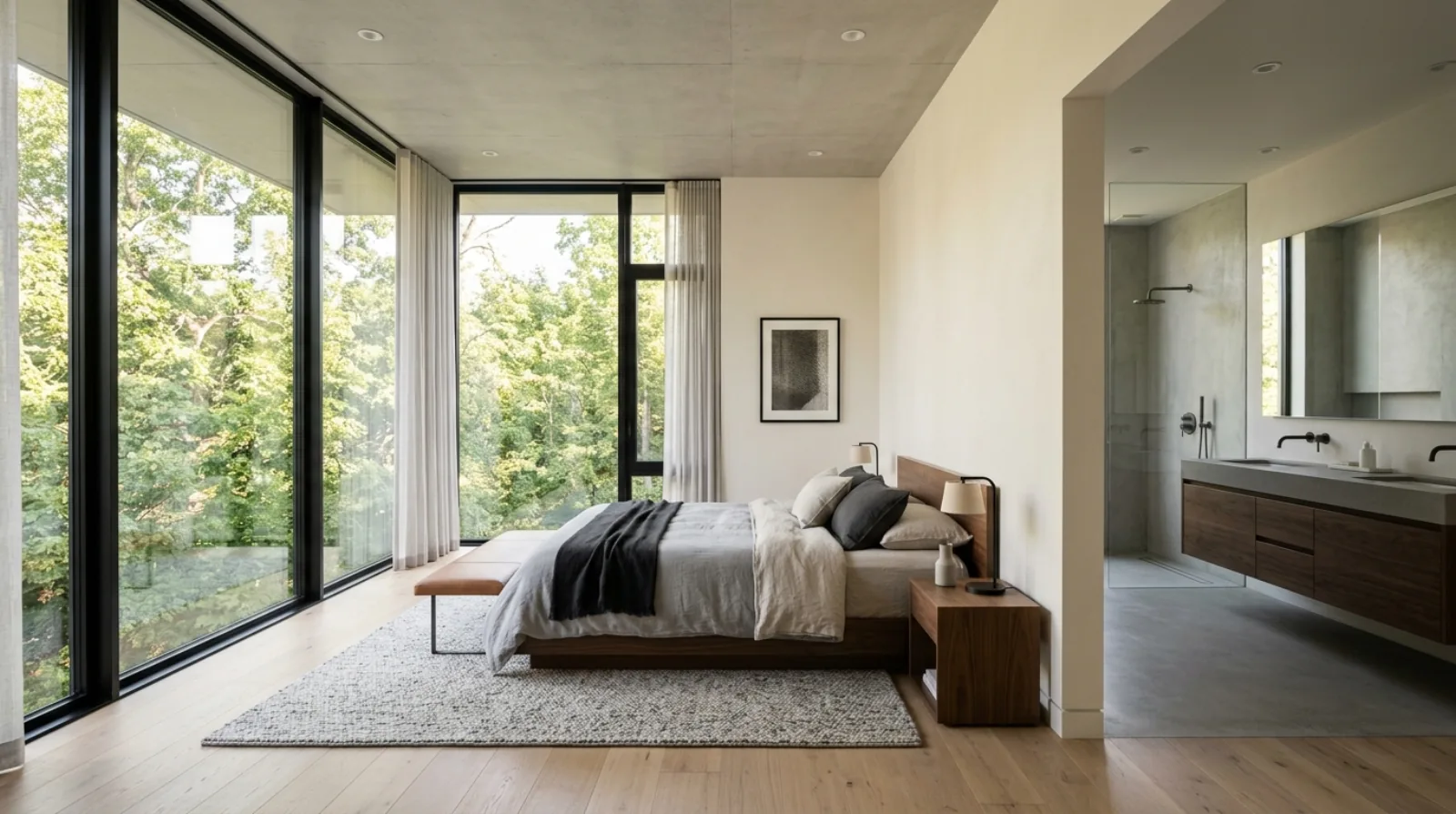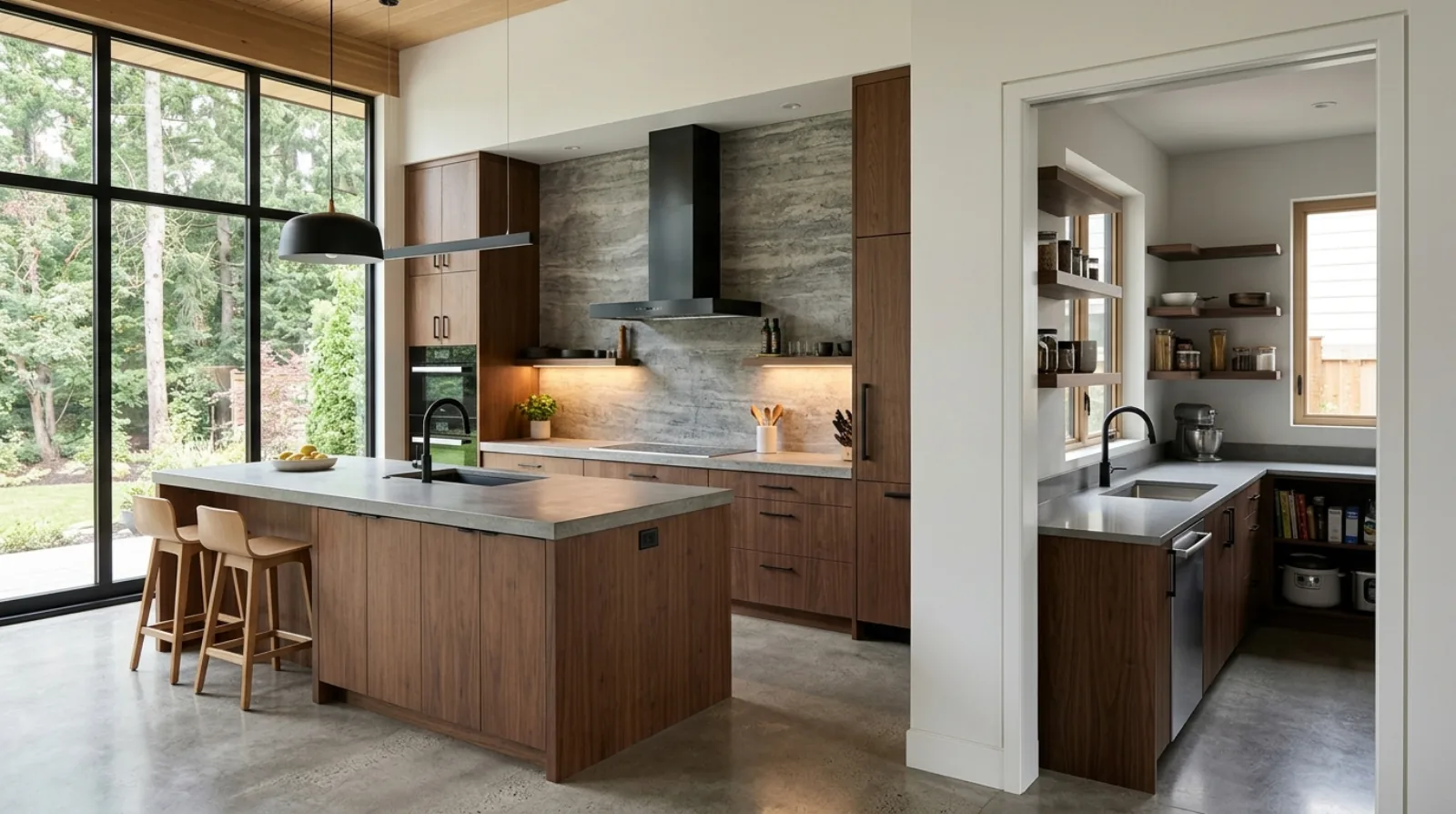
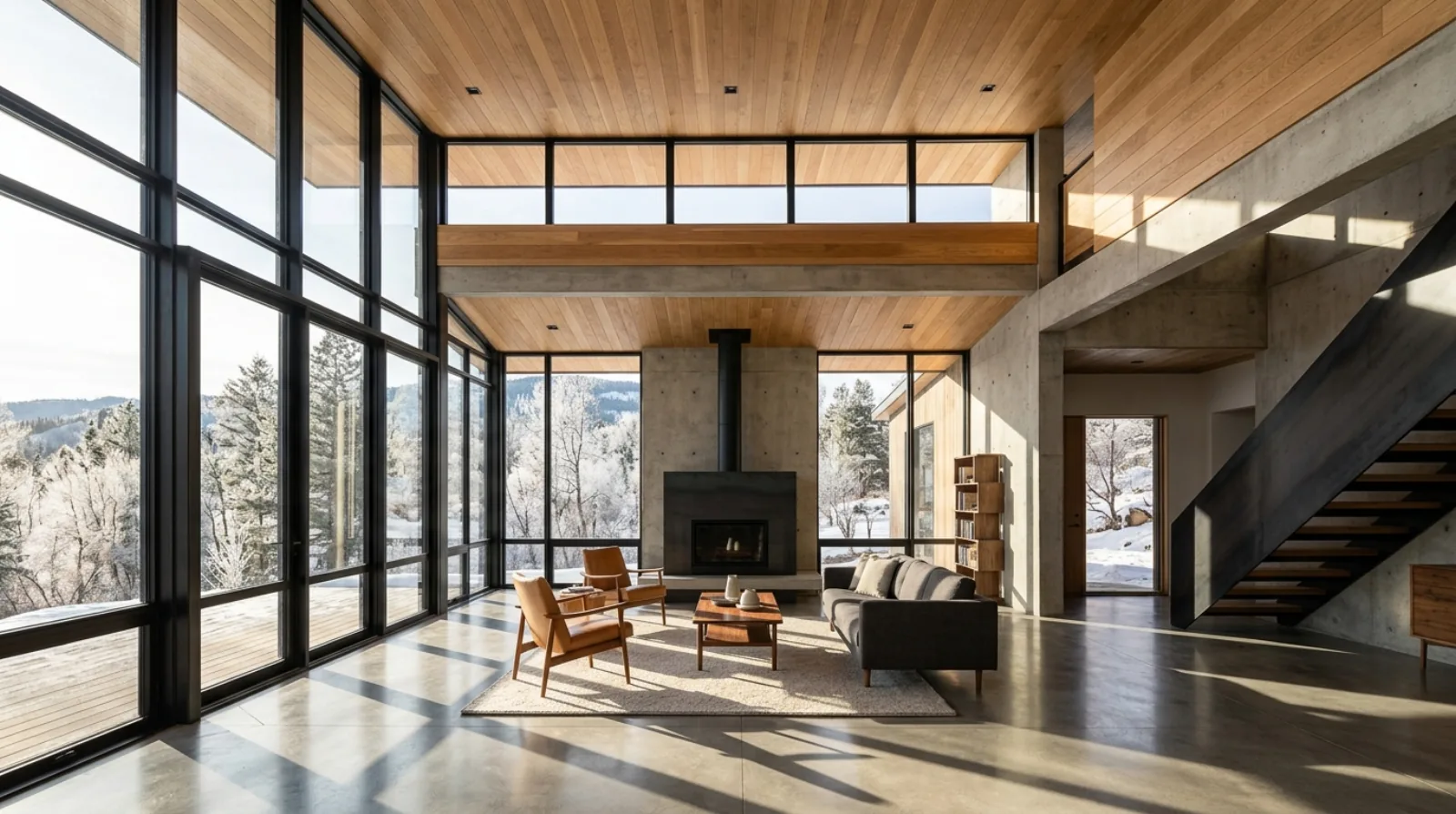
On the gray BC south coast, natural light is a plan-stage decision, not a window-shopping one. Where the glass goes, which rooms face the sun, and how high the heads sit decide whether a Burnaby home feels bright in December or dim by three o'clock.
Two rooms in a Burnaby house can be the same size, cost the same to build, and sit on the same lot, and one feels bright on a gray December afternoon while the other has the lights on at three o'clock. The difference almost never comes down to the windows you bought. It comes down to where they went, which way the room faces, and how high the glass sits on the wall. All of that gets decided on paper, months before anyone orders a single unit.
That's the thing most people don't realize about natural light: it's a design decision made at the plan stage, not a window-shopping decision made later. By the time you're choosing frames and glazing, the daylighting is mostly already settled. The walls are where they are. The rooms face where they face. You can pick a better window, and you should, but a great window on the wrong wall is still a dim room.
I've written separately about the thermal side of glazing, frame material, the glass package, the install details that keep a window tight through a wet coast winter. This piece is the other half of the conversation, and the half that gets skipped: how a builder and architect place glass to get good natural light into the rooms that need it, without cooking the house in July or bleeding heat in January. On the gray BC south coast, getting this right is one of the highest-value design moves there is, and it doesn't cost more than getting it wrong.
Why daylighting is harder here than people think
Burnaby sits in a climate that's mild but cloudy for a long stretch of the year. From late fall into spring we get short days, low sun, and a lot of overcast. That changes the whole problem. In a sunny climate the design challenge is keeping heat and glare out. Here, the harder challenge is pulling enough usable light into the house through months when the sky is a flat gray lid and the sun, when it shows up, sits low and crosses the sky quickly.
Low winter sun is actually useful, it reaches deep into a south-facing room, much deeper than high summer sun does. But you only capture it if the room is pointed the right way and the window is placed to let it in. Miss the orientation and that low light rakes across a blank wall instead of lighting the space you live in.
There's also a tradeoff sitting underneath every glazing decision. More glass means more daylight, and it also means more heat loss in winter and more heat gain in summer. The BC Energy Step Code is the province's performance-based energy standard, it doesn't tell you which window to buy, but it sets airtightness and thermal targets the whole building has to hit, and a certified energy advisor verifies them with a blower-door test before the home gets its occupancy permit. Every extra square foot of glazing has to be paid for somewhere else in the envelope. So the goal isn't "more windows." It's the right windows, in the right walls, sized to the light each room actually needs. I get into the thermal side of that tradeoff in the companion piece on windows and glazing for a Burnaby winter; here I'm staying in the lane of light, orientation, and layout.
Orientation: the four sides do four different jobs
Before a floor plan is fixed, the first question I want answered is how the house sits on the lot relative to the sun. On the BC south coast the four orientations each do a distinct job, and a good plan assigns rooms to them deliberately.
South is the workhorse. Through our long gray winters, south-facing glass collects the most consistent, usable daylight, and the low winter sun reaches furthest into the room. It's also the easiest orientation to control in summer, because the high July sun can be blocked with a simple overhang while the low winter sun still slides in underneath. If there's one orientation you want your main living spaces facing, it's this one.
East is for morning rooms. East light is bright early and gone by midday. That makes it right for a kitchen and breakfast area, a primary bedroom you want waking up with the sun, or a home office used first thing. It's gentle light, low-angle but not yet hot.
North is steady and even. North-facing windows never get direct sun, which sounds like a loss but isn't. The light they deliver is soft, consistent, and shadowless all day, exactly what a studio, a craft room, or a workspace where you need true, even illumination wants. It's also the lowest summer-overheating risk of any orientation. The cost is that north glass is a pure heat-loss surface in winter, so you size it for the light you need and no more.
West is mostly about management. Late-day west sun is low, direct, and hits the eye as glare. A west window can be wonderful for catching an evening view, but a big unshaded west wall turns a living room into a glare box from spring through fall and adds real summer heat. I'll put glass on the west for a specific view or a room used in the evening, but I plan for shading from the start.
The single biggest layout move that follows from all this: put the rooms you live in during daylight hours on the bright sides, and bury the rooms that don't care on the dark sides. Kitchen, living, dining, daytime office, those go to the south and east light. Garage, mechanical room, pantry, storage, laundry, stairs, those are perfectly happy on the north and west, where they act as a buffer for the rooms that matter. I've seen too many plans where a powder room got the best southern exposure in the house and the family room got stuck against a north property line. That's a layout problem, and it's free to fix on paper and expensive to fix later.
Window head height: the number nobody talks about
Here's a detail that decides more about how a room feels than almost anything else, and it rarely comes up in client conversations: how high the top of the window sits on the wall.
The rule of thumb that's held up across every project I've worked on is that daylight penetrates into a room roughly in proportion to the head height of the glass. A window with its head up near the ceiling throws light far deeper into the room than the same-sized window with its head at standard height and a couple of feet of blank wall above it. Raise the head, and the light reaches the back of the room. Drop it, and the back of the room stays dim no matter how wide the window is.
This is why two windows of identical area can light a room completely differently. People obsess over window width because it's what you see on an elevation drawing. Head height is what you feel standing in the finished room in December. When I'm reviewing a set of drawings with a client, this is one of the first things I check on the deeper rooms, open-plan living spaces, especially, where the seating area is often well back from the glass.
It's also the argument for taller windows over wider ones in a lot of cases. A tall window with a high head daylights a deep room; a wide, short window lights a strip near the glass and leaves the rest gray. On the BC south coast, where the light is precious half the year, getting the head height right is one of the cheapest ways to make a room feel genuinely bright.
Clerestory windows, skylights, and light wells
When a room is deep, or it's pressed against a property line, or you want light without sacrificing wall space or privacy, the toolkit goes vertical. Each of these brings light from up high, and each carries a leak or heat risk that's sharper on a wet coast than a builder in a dry climate has to worry about.
Clerestory windows are a band of glass set high on the wall, up near the ceiling. They're one of my favourite daylighting tools here. They pull light deep into a room (because the head is high), they hold their privacy (you're not looking out at eye level into a neighbour's yard), and on a south or north wall they deliver steady, glare-free light to the back of a space that would otherwise stay dark. On a tight Burnaby lot where the side walls are close to the property lines, a clerestory above the sightline of the neighbouring house is often the cleanest way to light an interior room. They're wall openings like any other, so the install detailing is conventional, which makes them lower-risk than anything cut into the roof.
Skylights light a room from straight overhead, and on paper they're efficient. The catch is the roof. A skylight is a hole cut into the most weather-exposed plane of the building, on a coast that throws horizontal rain at it for a good part of the year. Every skylight is a flashing detail that has to be perfect and stay perfect, and a poorly flashed skylight is one of the most reliable leak sources in residential construction. There's a heat side too: an overhead skylight gets the high summer sun beating straight down through it, which can overheat a room badly, and it's a heat-loss path in winter. I'll use skylights, but I treat them as a serious detail, not a casual one, I want them well-flashed, ideally on a curb, sized and placed so summer overheating is manageable, and I'd rather solve a daylighting problem with a clerestory or a taller wall window first if the room allows it.
Light wells, a shaft that channels light down from a skylight or upper window into a lower space, are the most ambitious of the three and carry all the skylight risks plus the complexity of the shaft itself. They can be spectacular when a stairwell or a central core needs light. They're also the most expensive to get right and the most punishing to get wrong. I'd only go there with a clear reason and a detailing budget to match.
Shading: blocking summer sun, keeping winter sun
The elegant thing about the sun on the BC south coast is that you can have it both ways on a south-facing wall, because summer sun and winter sun arrive at completely different angles. Summer sun is high overhead. Winter sun is low. A properly sized overhang above a south window blocks the high summer sun before it ever hits the glass, while letting the low winter sun slide in underneath exactly when you want the free heat and light.
That's a passive design move that costs almost nothing if it's drawn in from the start, it's just roof geometry, and it's hard to retrofit later. Get the overhang depth right for the latitude and the window head height, and a south room stays comfortable in July and bright in January with no moving parts, no blinds, no mechanical anything. It's one of the few decisions in homebuilding that's both nearly free and genuinely durable.
West windows don't get the same easy fix, because the low evening sun comes in under any horizontal overhang. There you're looking at vertical shading, fins, deep reveals, exterior screens, landscaping, or simply being disciplined about how much west glass you put in a room you use in late afternoon.
The overheating tradeoff and the 26-degree room
There's a hard line in the code now that every daylighting decision has to respect. Since March 2024, the BC Building Code has required that new dwelling units include at least one living space capable of being kept at no more than 26°C, even at the summer design temperature, requirement 9.33.3.1.(2). The province brought this in after the 2021 heat dome, and it's now a design constraint, not a nice-to-have.
This matters for daylighting because the same glass that delivers beautiful light can also overheat a room. A wall of unshaded west or south-facing glass is a fast way to turn a living space into one that overheats in summer, and now there's a code provision that interacts directly with how much glass goes where and how it's shaded. The way you satisfy it cleanly is the same passive thinking I've already described: orient the main living spaces to manageable light, shade the south glass with overhangs, keep the west glass disciplined, and use mechanical cooling to back it all up rather than to rescue a glazing layout that fights the sun. Daylighting and overheating are the same problem looked at from two directions, and on a custom home you solve them together at the plan stage.
Burnaby's slopes: where view and sun don't agree
Burnaby's best lots come with a complication that flat-lot daylighting doesn't have: the view and the sun are frequently pointed in different directions. On Capitol Hill, in Burnaby Heights, around Deer Lake, the hillside neighbourhoods people build custom homes in precisely for the outlook, the view often faces north toward the inlet and the mountains, while the sun you want for daylighting is to the south, behind the house.
That's a genuine design tension, and it's where the orientation thinking earns its keep. You can't always have the view window and the sun window be the same window. So you plan for both: capture the north view with glass sized and detailed knowing it's a heat-loss surface, and pull your daytime light from the south and east through clerestories, a taller window head, or rooms deliberately arranged to face the sun even when the headline view is the other way. Designing a home around a Burnaby view lot is partly the craft of getting both the outlook and the light without letting one wreck the other, and on a sloped lot the level changes give you extra room to work, because windows on different floors see past each other to different parts of the sky.
The slope itself is a daylighting asset if you use it. Stepping a house down a hillside lets upper-level glass catch sun that a flat lot would put a neighbour's roof in the way of, and lets you stack clerestories and light wells in ways that bring sun into the lower, dug-in parts of the house that would otherwise be dark.
How this actually gets decided
The reason I keep coming back to "plan stage" is that daylighting is one of the few parts of a custom home where the right decision and the wrong decision cost the same. Pointing the kitchen at the morning sun instead of the back fence is free. Raising a window head a foot is free. Drawing an overhang that blocks July sun and admits January sun is free. Putting the garage on the dark side is free. None of these are budget line items, they're just decisions, and they have to be made while the plan is still on paper and the walls can still move.
That's the conversation I want to have with a client and their architect early, before the floor plan is locked and long before windows become a shopping list. We walk the lot, we figure out where the sun comes from across the seasons, we work out where the view is and whether it fights the light, and we assign rooms to orientations on purpose. Get that right and you've built a home that's bright through a Burnaby winter for no extra money. Skip it, and you spend the next thirty years with the lights on at three in the afternoon in a room that should have been full of sun.
If you're at the planning stage on a custom home in Burnaby, Vancouver, North Vancouver, Coquitlam, or New Westminster, send me the lot and the early plans. I'll walk through how the sun moves across your specific site and where the glass should go to make the rooms you live in feel bright on the grayest day of the year.
Related on the Journal
- Windows and glazing for a Burnaby winter
- Designing a Burnaby view-lot custom home
- Hillside homes on Capitol Hill and Burnaby Heights
Frequently asked questions
- Which way should a Burnaby custom home face for the best natural light?
- On the BC south coast, you want your main daytime living spaces, kitchen, living, dining, facing south and east. South light is the most consistent through a gray winter and the easiest to shade in summer with an overhang; east light is gentle morning light. North gives steady, even, shadowless light that's ideal for a studio or workspace. West light is mostly something to manage, because low evening sun reads as glare. The bigger move is putting the rooms you actually use during the day on the bright sides and the garage, storage, and utility rooms on the dark sides.
- Does the BC Building Code set a minimum window size for bedrooms?
- Yes. Under Section 9.9.10 of the BC Building Code, every bedroom must have at least one outside window (or exterior door) that opens from the inside without keys or tools, providing an unobstructed opening of at least 0.35 square metres with no dimension less than 380 millimetres. That's an emergency-egress requirement, not a daylighting one, but in practice it means no bedroom can be windowless. Good daylighting usually calls for more glass than the code minimum, the minimum is a floor, not a target.
- Do skylights leak on the wet coast?
- They can, and it's the main reason to treat them carefully here. A skylight is a hole cut into the most weather-exposed plane of the building, on a coast that gets a lot of wind-driven rain. The flashing has to be detailed properly and stay intact for decades, a poorly flashed skylight is one of the most reliable leak sources in residential construction. Skylights also collect high summer sun, which can overheat a room, and lose heat in winter. They're a legitimate daylighting tool, but a dark room is often better solved with a high clerestory window first, since a wall opening is far lower-risk than a roof penetration.
- What is a clerestory window and why use one?
- A clerestory is a band of glass set high on a wall, up near the ceiling, above normal sightlines. Because the window head is high, it throws daylight deep into a room, much further than a standard-height window of the same size. It also preserves privacy, since you're not looking out at eye level, and it frees up the lower wall for furniture or cabinets. On a tight Burnaby lot where the side walls sit close to the neighbours, a clerestory above the neighbouring rooflines is often the cleanest way to light an interior room without skylights.
- How does window head height affect how bright a room feels?
- More than most people expect. Daylight reaches into a room roughly in proportion to how high the top of the window sits. A window with its head near the ceiling lights the back of the room; the same-sized window set lower, with blank wall above it, leaves the back of the room dim. That's why two windows of identical area can light a space completely differently. In deep, open-plan rooms it's one of the first things worth checking on the drawings, and it's often a stronger argument for a tall window than a wide one.
- Can a Burnaby home have a great view and good natural light if they face different directions?
- Usually yes, with planning. On Burnaby's hillside lots, Capitol Hill, Burnaby Heights, Deer Lake, the view often faces north toward the inlet and mountains while the daylight you want is to the south behind the house. The answer is to design for both rather than picking one: capture the view with north glass sized knowing it loses heat, and pull daytime light from the south and east using clerestories, taller window heads, and rooms arranged to face the sun. The slope itself helps, because windows on different levels see past each other to different parts of the sky.
- Will more windows make my home harder to heat or cool?
- Glass is the weakest part of the thermal envelope, so more of it means more heat loss in winter and more heat gain in summer. The BC Energy Step Code sets airtightness and thermal targets the whole building has to meet, verified by a blower-door test, so extra glazing has to be paid for elsewhere in the envelope. The goal isn't maximum glass, it's the right glass in the right walls, sized to the light each room needs, with south-facing windows shaded by overhangs so they don't overheat the house in summer.
- Is daylighting something I decide when choosing windows?
- No, and that's the most common misunderstanding. By the time you're picking frames and glazing, the daylighting is mostly already set, because the walls and room orientations are fixed. Which way each room faces, how high the window heads sit, where the overhangs go, which rooms get the bright sides, all of that is decided at the plan stage with the architect, often for no extra cost. Window selection then handles the thermal performance of glass you've already placed well.