
Maintenance
Years two to ten in a BC custom home: the maintenance plan that protects your 2-5-10 warranty
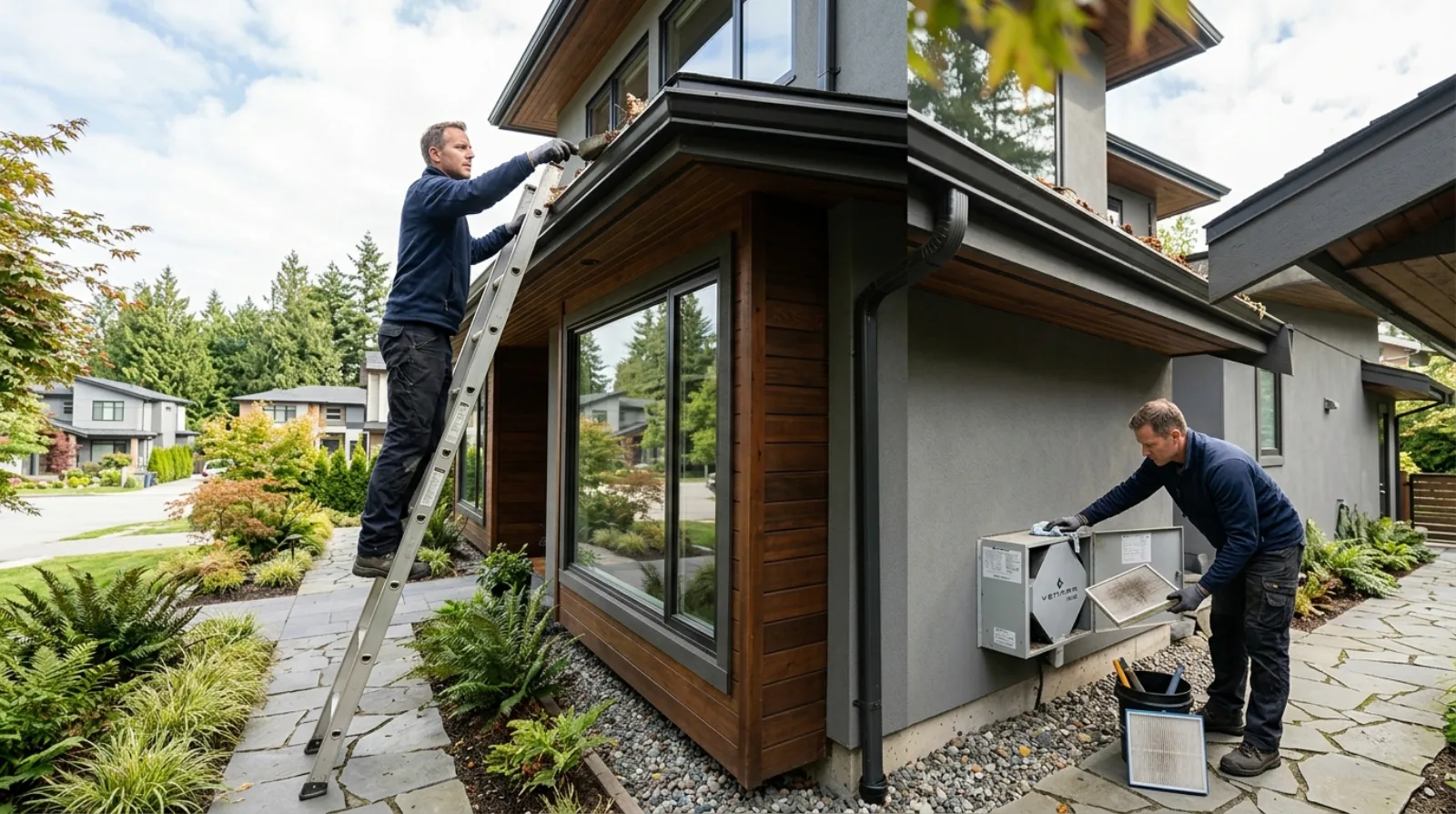
After the first-year walkthrough, the 2-5-10 warranty still has nine years to run, and the regulation lets a warranty provider exclude damage caused by poor maintenance. Here is the sealant, roof, deck, HRV, heat pump and water heater schedule we give Burnaby owners for years two to ten, with each interval taken from BC Housing or Natural Resources Canada.
The year-end walkthrough is where most owners stop thinking about the warranty. The 12-month layer has closed, the settlement cracks are filled, and the house feels finished. On a Burnaby or Coquitlam custom home, though, the BC 2-5-10 warranty still has nine years to run, and from year two onward the owner's maintenance decides how much of that coverage you can still use.
This post starts where our first-year maintenance playbook ends. The seasonal tasks (gutters, hose bibs, the first sump test, the fireplace service) are in the first fall and winter checklist, so we will not repeat them here. What follows is the longer schedule: what to check each year, and what to book before each warranty layer closes.
What the warranty expects from you after year one
BC Housing's warranty summary sets out the layers. On a detached home, defects in materials and labour are covered for 12 months. The electrical, plumbing, and heating, ventilation and air conditioning systems, plus exterior cladding, windows and doors, are covered for 24 months. The building envelope, including unintended water penetration that could cause damage, is covered for five years. Structural defects in load-bearing parts are covered for ten. On a custom home, the clock starts at occupancy or the first occupancy permit, whichever comes first.
The Homeowner Protection Act Regulation is where the owner's side is written down. Section 11 lets a warranty provider exclude, among other items:
- weathering, normal wear and tear, and deterioration consistent with normal industry standards
- damage caused or made worse by negligent or improper maintenance or improper operation by anyone other than the builder
- damage from failing to follow the warranty requirements of the manufacturers of appliances, equipment or fixtures
- damage from alterations, including converting non-living space into living space, and from changes to the grading of the ground by anyone other than the builder
- damage from an owner's failure to take timely action to prevent or minimize loss, including failing to give prompt notice of a defect
BC Housing's page on maintenance on homes says it plainly: an owner could limit their coverage through negligent or improper maintenance.
Section 14 of the regulation says those maintenance conditions and exclusions apply only to maintenance requirements the builder or warranty provider gave to the original owner. So the maintenance manual and the equipment manuals from handover are the documents that define your obligations. Keep them in one place, and keep a dated log of what you did and who did it. That log is the evidence that you met your side of the policy.
From year two, the maintenance log is a warranty document. A dated photo of a clean HRV core is stronger evidence in a claim than a memory of doing the work.
Icon Projects Team
Sealants and caulking: the five-year envelope depends on them
Exterior sealant is the most important maintenance item on a Lower Mainland house between years two and five, because it sits in the joints the five-year envelope coverage is about: window perimeters, cladding transitions, penetrations for vents and pipes.
BC Housing's Maintenance Matters bulletin on sealants says sealants should be reviewed every year, or as your maintenance manual specifies, and that the action taken depends on what the review finds: cleaning, touch-up, repair or replacement. The bulletin lists the five signs of failure to look for:
- loss of adhesion, where the sealant separates from the surfaces it was applied to
- loss of cohesion, meaning cracks or splits within the sealant itself
- loss of elasticity, where the bead is no longer flexible
- weathering, such as blistering, chalking, discolouration or cracking
- improper installation
The same bulletin gives expected service lives by type. It lists 10 to 50 years for silicone, 5 to 20 years for polyurethane and polysulfide, and 2 to 10 years for butyl and asphalt. It also points out that sealant on the south side of a building, in the sun, can need replacement long before the sealant on the north side. On a Burnaby Heights lot with a south-facing rear wall of glass, that is the wall we check first.
BC Housing treats sealant inspection and replacement as a job for a professional. Our practice: the owner walks the house each spring with a camera and photographs every joint that shows one of the five signs, and in year four we suggest a review by a building envelope consultant or by us, so that any repair is done and documented before the five-year envelope layer closes.
Roof, gutters and roof drains
BC Housing's Maintenance Matters bulletin on roofs recommends inspecting a roof twice a year: in spring to deal with winter damage, and in fall to prepare for the winter snow and rain. It adds an inspection after any storm with high winds, extreme rain or hail. The bulletin lists what to watch for, including moss, which holds moisture on the roof and speeds up the breakdown of roofing materials, and overflowing eavestroughs or scuppers, which point to blocked drains.
On a flat roof in Burnaby or Vancouver, we check the drains and scuppers first. On a pitched roof under the cedars of Deer Lake or Forest Glen, we track moss on the north slope. The bulletin recommends a qualified roofing contractor for the inspection. The owner books it twice a year and keeps the report.
Decks, guardrails and exterior wood
Water that gets past a deck membrane goes straight into the framing below. BC Housing's Maintenance Matters bulletin on decks and balconies says deck and balcony membranes should be inspected at least every two years. For a new building it asks for an inspection before the end of year one and again before the end of year two, because the wood frame shrinks as it dries and can pull the membrane away from the wall. It also recommends checking the condition and strength of guardrails every two years, keeping scuppers clear and checking their attachment each year, and cleaning deck surfaces, drains and gutters at least twice a year.
That year-two membrane inspection lines up with the close of the 24-month layer, which covers exterior cladding, caulking, windows and doors where a defect could lead to detachment or material damage. If a membrane has pulled away at the wall, you want that found and reported in month 22.
Open wood decks and exterior wood follow a different schedule. The first finish on a new cedar deck goes on after its first dry summer, as our first-winter checklist explains. After that, the finish product's label sets the recoat interval, and exposure decides the rest. Our practice is to check each spring by sprinkling water on the boards: where the water soaks in instead of beading, that area is due. South-facing boards and stair treads wear through first. The same spring check covers cedar soffits, fascia and any exposed timber at the entry.
HRV, heat pump and water heater
Every piece of mechanical equipment comes with its own service requirements, which is where the manufacturer exclusion in section 11 applies.
HRV. Natural Resources Canada's guide to heat recovery ventilators sets out a seven-step schedule. Clean or replace the filters every one to three months. Keep the outside intake and exhaust hoods clear of leaves, snow and frost. Inspect the heat-exchange core twice a year and clean it as needed. Check the condensate drain and pan twice a year by pouring warm water into the pan and watching it drain. Look inside the ducts at least once a year; the guide says professional duct cleaning is usually needed only once every two years. The seventh step is an annual service by a contractor accredited by the Heating, Refrigeration and Air Conditioning Institute of Canada.
If you cannot find the core or the condensate drain on your unit, ask us or your installer to show you once.
Heat pump. Natural Resources Canada's heat pump page says to change or clean the air filter every three months and to have a qualified contractor do annual maintenance on the unit. Keep the invoice from each visit. If the heat pump fails in year eight, the service history is the first thing anyone will ask for.
Water heater. For a gas water heater, Technical Safety BC's bulletin on annual servicing of gas appliances says the work should be done by a certified gas fitter employed by a licensed gas contractor, and its water heater checklist includes the pressure and temperature relief valve, the expansion tank where there is one, and the venting system. If your house has an electric heat pump water heater instead, the manufacturer's manual is the service schedule, and it is the document the section 11 exclusion points to. Read it in year two, put its intervals in the calendar, and follow them.
Drainage, grading and the changes owners make
By year two the sump pump and the perimeter drain have worked through at least one wet season. Keep testing the pump each fall as the first-winter checklist describes. If the pump starts running more often than it did in the first year, or the pit shows silt, have a drain contractor put a camera through the cleanouts.
The larger risk in these years comes from changes the owner makes. The regulation's alteration and grading exclusions cover a finished basement, a new patio that slopes toward the wall, or a garden bed built up against the cladding. In Burnaby and New Westminster we see the grading one most often: new landscaping raises the soil at the foundation wall, and the rain that used to run away from the house now runs toward it. Before you finish a basement or reshape the yard inside the warranty period, read the policy and ask the provider in writing.
A ten-year calendar
Section 15 of the regulation requires the warranty provider to give the owner a schedule of the expiry dates for each coverage. Put those dates in your calendar, and then build the maintenance around them.
- Every year: sealant review in spring, roof inspection in spring and fall, deck drains and gutters cleaned at least twice, HRV core and condensate drain checked twice, HRV and heat pump serviced by a contractor, water heater serviced to its manual or Technical Safety BC's checklist.
- Month 20 to 22: walk the house for anything in the 24-month layer: heating and ventilation, plumbing, electrical, cladding, caulking, windows and doors. Inspect the deck membrane before the end of year two. Report anything in writing.
- Every two years: deck and balcony membranes and guardrail strength, per BC Housing.
- Year four: envelope review by a consultant or your builder, with repairs documented before the five-year envelope layer closes.
- Year nine: look at the structure. Floors that have started to slope, doors that no longer close, or cracks that keep growing go to the provider before year ten.
Section 16 of the regulation requires written notice to both the warranty provider and the builder, within a reasonable time after you find a defect and before the coverage expires. Our guide to making a warranty claim after move-in walks through that notice. The owners who do well in years two to ten send it early, with photos and a maintenance log behind it.
Frequently asked questions
- How long does the BC 2-5-10 home warranty cover a custom home?
- BC Housing's summary sets out three layers. Defects in materials and labour are covered for 12 months on a detached home, with 24 months for the electrical, plumbing and heating, ventilation and air conditioning systems, exterior cladding, windows and doors. The building envelope, including unintended water penetration that could cause damage, is covered for five years, and structural defects in load-bearing parts are covered for ten. On a custom home, coverage starts at occupancy or the first occupancy permit, whichever comes first.
- Can poor maintenance reduce my home warranty coverage in BC?
- Yes. The Homeowner Protection Act Regulation lets a warranty provider exclude damage caused or made worse by negligent or improper maintenance by anyone other than the builder, and damage from failing to follow the maintenance requirements of the manufacturers of appliances, equipment or fixtures. BC Housing states that owners could limit their coverage through negligent or improper maintenance. Those exclusions only apply to maintenance requirements the builder or warranty provider gave to the original owner, so keep the maintenance manual you received at handover.
- How often should exterior caulking and sealants be checked on a BC house?
- BC Housing's Maintenance Matters bulletin on sealants says sealants should be reviewed every year, or as your maintenance manual specifies. The same bulletin lists expected service lives from 2 to 10 years for butyl and asphalt sealants up to 10 to 50 years for silicone, and notes that sealant on the sunny south side of a building can need replacement long before the north side. It treats inspection and repair as work for a professional.
- How often should the roof be inspected on a Burnaby custom home?
- BC Housing's Maintenance Matters bulletin on roofs recommends an inspection twice a year: in spring to deal with any winter damage and in fall to prepare for the winter rain. It also recommends an inspection after any storm with high winds, extreme rain or hail. On a Burnaby lot under tall trees, we pair the fall inspection with the gutter clean-out.
- What HRV maintenance does a homeowner need to do each year?
- Natural Resources Canada's guide to heat recovery ventilators says to clean the filters every one to three months, inspect the heat-exchange core twice a year and clean it as needed, check the condensate drain and pan twice a year, and keep the outside intake and exhaust hoods clear. It also recommends annual servicing by a contractor accredited by the Heating, Refrigeration and Air Conditioning Institute of Canada.
- How often should deck membranes be inspected on a new BC home?
- BC Housing's Maintenance Matters bulletin on decks and balconies says membranes should be inspected at least every two years, and that owners of a new building should inspect decks, balconies and railings before the end of year one and again before the end of year two, because wood shrinkage can pull the membrane away from the wall. It also recommends checking guardrail strength every two years and cleaning deck drains and gutters at least twice a year.
- Does finishing a basement or regrading the yard affect the BC home warranty?
- It can. The Homeowner Protection Act Regulation lets a warranty provider exclude damage caused or made worse by alterations to the home, including converting non-living space into living space, and by changes to the grading of the ground, when that work is done by someone other than the builder. Before a Burnaby or Coquitlam owner finishes a basement or reshapes the yard inside the warranty period, we suggest reading the policy and asking the provider in writing.
- How often should a water heater be serviced under BC's home warranty rules?
- To the schedule in its own manual, because that manual is the document the maintenance exclusion in section 11 of the Homeowner Protection Act Regulation points to. For a gas water heater, Technical Safety BC's bulletin on annual servicing of gas appliances calls for the work to be done by a certified gas fitter employed by a licensed gas contractor, checking the pressure and temperature relief valve, the expansion tank where fitted, and the venting system. An electric heat pump water heater instead follows its own manufacturer's schedule.
- What written notice does a BC homeowner need to give to keep a warranty claim valid?
- Section 16 of the Homeowner Protection Act Regulation requires written notice to both the warranty provider and the builder within a reasonable time after a defect is found, and before that layer of coverage expires. Section 15 requires the warranty provider to give the owner a schedule of expiry dates for each coverage layer at the start, so those dates, plus a dated maintenance log, are what an owner needs on hand when sending notice.

