A tight, code-current Burnaby home saves energy, but it's only healthy if you design the air on purpose. Radon control, balanced ventilation, and summer overheating are now code, not upgrades. Here's how they fit together.
A tight, code-current Burnaby custom home is energy-efficient almost by default now. What it isn't, automatically, is healthy. Those are two separate design problems, and the second one, the air you actually breathe, the radon under the slab, whether the house cooks you in a July heat wave, is the one that gets quietly dropped when the budget gets tight.
The good news is the BC code stopped treating clean air and summer comfort as optional. A new home in Burnaby now needs a radon rough-in built into the slab, balanced mechanical ventilation, and at least one living space the design can keep at or below 26°C in a heat wave. None of those are upgrades you bolt on at the end. They get drawn before the concrete is poured, or they don't get done well at all.
This is the post I hand to owners who've already wrapped their heads around the energy side, the heat pump, the airtightness numbers, and are ready to think about the part of the build that decides how the house feels to live in for the next thirty years.
Why a tight house needs the air designed on purpose
Start with the thing that makes all of this necessary: the house can't breathe on its own anymore.
An older Burnaby home leaked. Gaps around windows, an uninsulated rim joist, a furnace pulling combustion air through a hundred small holes in the envelope. That leakage was wasteful, but it also meant the house exchanged its indoor air with outdoor air constantly, whether anyone wanted it to or not. Stale air, cooking moisture, and the off-gassing from carpets and cabinets all got diluted by accident.
A current envelope doesn't leak like that. The airtightness targets behind the BC Energy Step Code seal the house tight enough that pulling a single bathroom fan can't find replacement air except through a cracked window. That's exactly what you want for the energy bill. It's also why the air inside has to be managed deliberately. Seal a house and stop there, and you've trapped the moisture, the carbon dioxide from people breathing, and whatever the materials are giving off, with nowhere for any of it to go.
So a healthy build is really four jobs stacked on top of the energy work: keep the soil gas out, move fresh air through on purpose, filter what comes in, and don't let the house overheat in summer. The code now requires most of this. Doing it well is still on the builder.
Radon: the rough-in that's now required everywhere in BC
Radon is a colourless, odourless gas that comes up out of the ground as uranium in the soil and rock breaks down. Outdoors it disperses to nothing. Indoors, in a sealed house, it can build up, and long-term exposure raises lung cancer risk. That's the whole reason it's worth designing around.
Here's the change a lot of owners haven't caught up to. The BC Building Code used to exempt low-probability areas, much of the coast included, from the radon rough-in requirement. As of permits applied for on or after March 8, 2024, that exemption is gone. New houses across the province, Burnaby included, now have to be built with a rough-in for what's called a subfloor depressurization system, unless the home is designed for radon protection under Parts 5 and 6 instead. The province made the change because newer data showed radon turning up in places the old maps said it wouldn't, and one house can read differently from its neighbour.
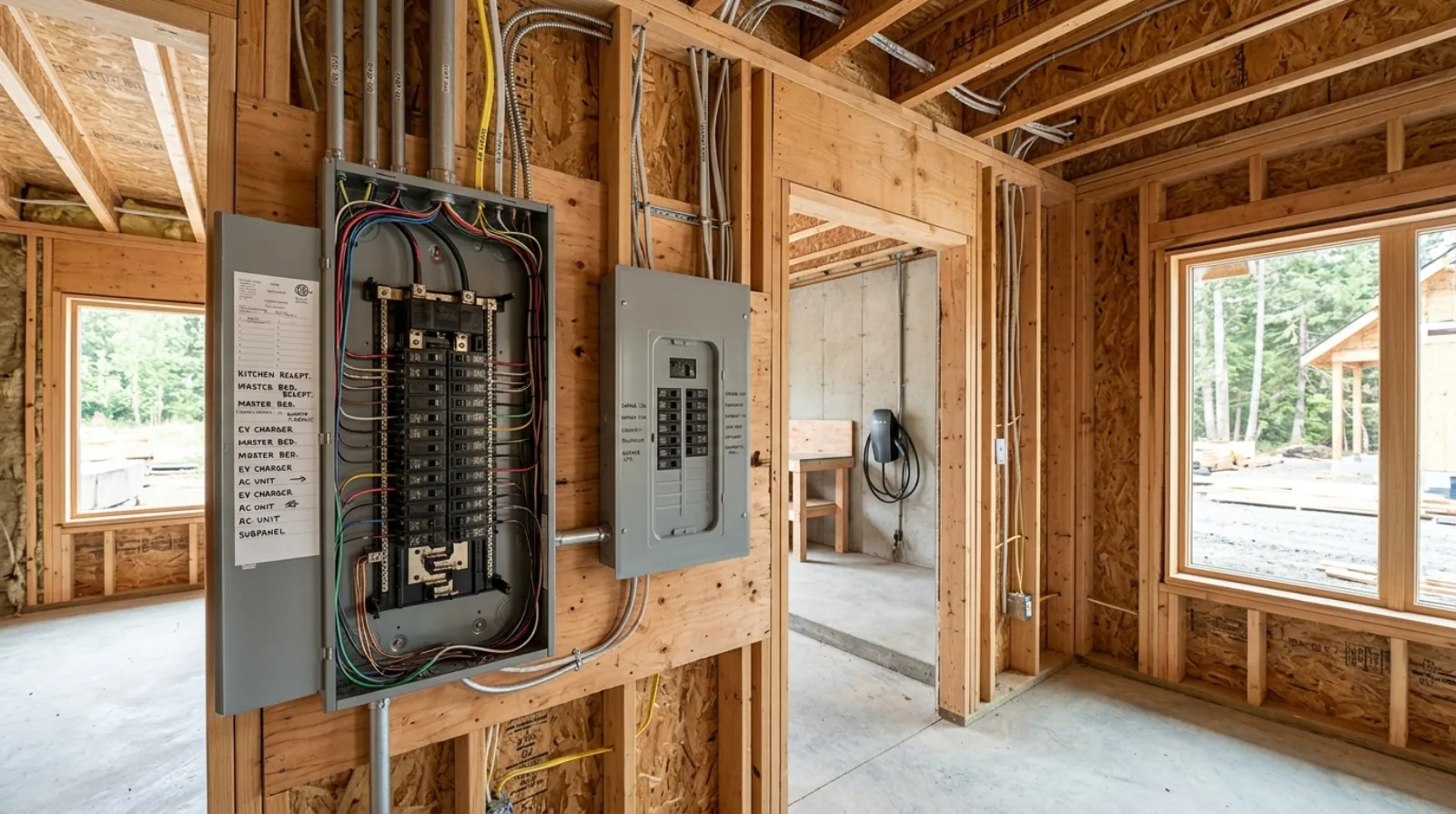
What the rough-in actually is, in plain terms: under the basement slab you lay a gas-permeable layer, coarse clean gravel or a dimpled membrane, and over it a continuous, sealed air barrier conforming to Subsection 9.25.3 of the code. Then a sealed vent pipe runs from that gravel layer, up through the house, and out, usually best routed vertically through warm interior space and out the roof, so the natural rise of warm air helps pull soil gas up and out. The rough-in stops there: it's the pipe, ready for a fan to be added later if testing says you need one.
A few field notes that matter:
- The code doesn't require an active fan. It requires the rough-in. But on a new build I think it's worth running the dedicated electrical and leaving the fan location accessible, adding a fan to a roughed-in system later is a small job; cutting one into a finished basement is not.
- Where the pipe ends matters. The termination has to be away from windows and air inlets so soil gas can't get pulled back into the house. This is a detail the rough-in plan needs to get right, not something to sort out on site.
- Testing is the owner's job, after move-in. The code covers design and construction; it doesn't test your finished house. Health Canada and BC Lung both recommend a long-term test, at least three months, run through the heating season with the windows closed, when levels tend to be highest.
On the geography question, owners on the coast often assume radon is purely an Interior problem. There's something to that. The BC Centre for Disease Control's radon map shows the Interior and the North with a far higher share of homes above the guideline than Metro Vancouver and the rest of the coast. But "lower on average" is not "zero," which is exactly why the province dropped the coastal exemption, and why I'd still test any finished home. The guideline to test against is Health Canada's, at 200 becquerels per cubic metre; above that, they recommend taking action to bring the level down. The rough-in is what makes that action straightforward instead of a renovation.
Balanced ventilation: the HRV is doing the breathing now
Once the house is sealed, something has to move the air for it. The code is direct about this. Section 9.32 of the BC Building Code requires every dwelling unit supplied with electrical power to have a mechanical ventilation system, a principal system that supplies fresh air to the bedrooms and every floor level and exhausts stale air from the kitchen and bathrooms. It's not a recommendation buried in a guide. It's a requirement, and the code explicitly contemplates a heat-recovery ventilator doing the job.
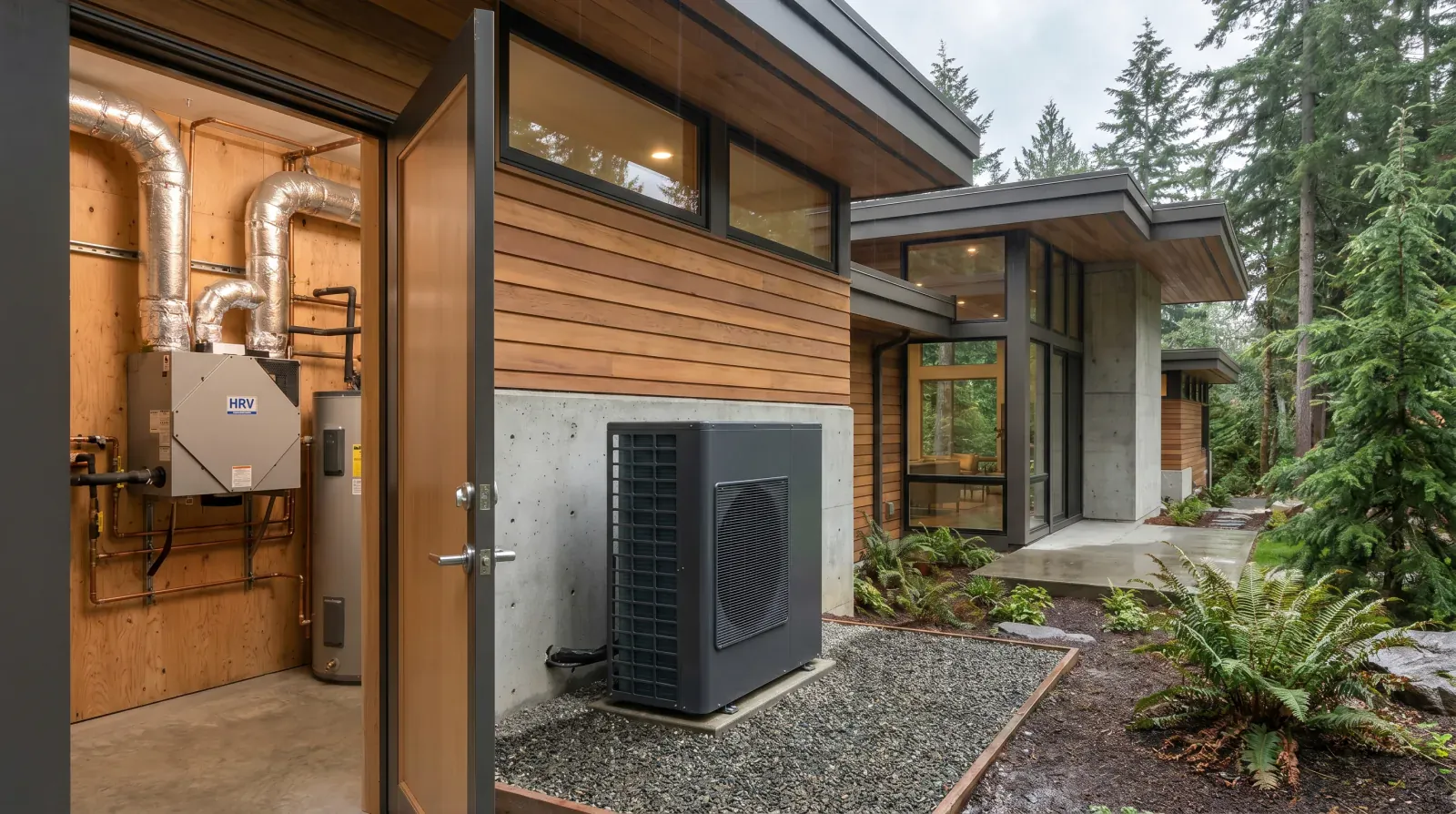
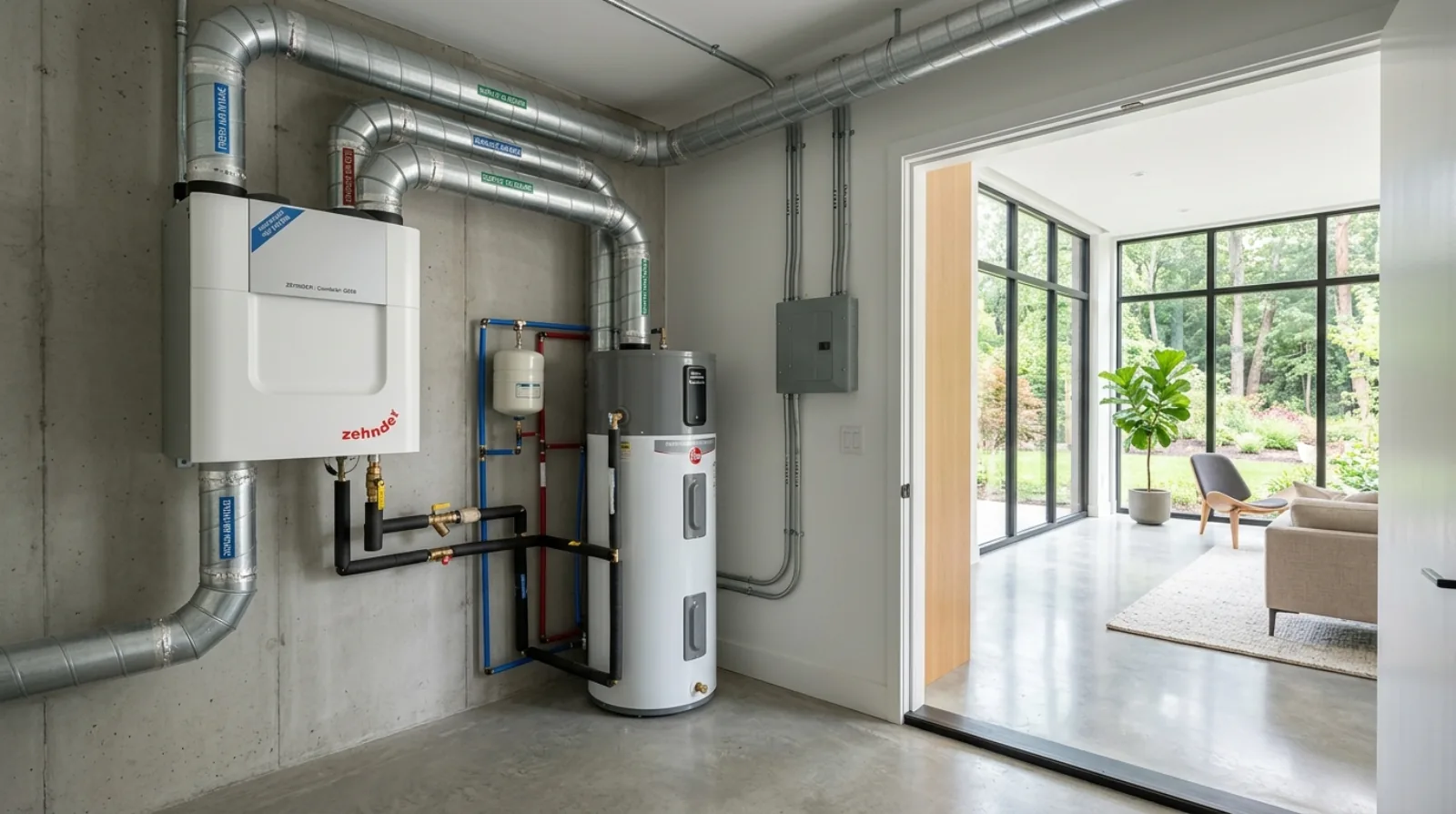
"Balanced" is the word that matters. A bathroom fan on its own is exhaust-only, it throws air out and, in a tight house, struggles to pull replacement air in. Balanced ventilation supplies and exhausts in roughly equal measure, so the house doesn't end up under negative pressure (which, incidentally, is one of the things that can pull soil gas up through any weakness in that radon air barrier). The tool for the job is an HRV, a heat-recovery ventilator, which runs the outgoing stale air past the incoming fresh air through a core, handing off most of the heat so you're not throwing your heating energy out the wall.
An unbalanced ventilation system is the comfort complaint nobody can name. The heat pump's failures are obvious, a cold room, a noisy register. Bad ventilation just leaves the house feeling stuffy, or stale, or weirdly drafty, and the owner lives with it for years without knowing what to ask for.
Icon Projects Team
For most Burnaby homes I spec an HRV over an ERV. The difference: an ERV (energy-recovery ventilator) also moves humidity between the two air streams. On the wet coast, where we're not short of moisture most of the year, the HRV's heat-only exchange is usually the better fit, and in mid-winter an ERV can hold a little too much humidity inside and raise condensation risk on cold surfaces. The drier Fraser Valley in summer, or a crowded household, can argue for an ERV, that's a call the mechanical designer makes per project. The deeper version of this conversation, including sizing and ducted-versus-ductless, is in our heat pump and HRV piece.
The piece owners underweight is the ducting. An HRV is only as good as the network distributing its air, and that network has to be designed into the house, not threaded through whatever space is left after framing. I've inherited HRVs that were good equipment strangled by an afterthought duct layout. The air never reached the rooms it was supposed to, and the owner just thought the house was stuffy.
Filtration: one good filter on the supply side
Fresh air from outside still carries pollen, wildfire smoke, and road dust, and on the BC south coast, late-summer smoke has become a regular enough visitor that it belongs in the design conversation. The answer is filtration on the air the system brings in.
Filters are rated by MERV, a scale where higher numbers catch finer particles. For a custom home I aim for a filter in the higher residential range, enough to catch fine smoke and pollen particles, sized into a ducted system where there's room for a proper filter housing and the airflow to push through it. The trap to avoid is speccing a high-rating filter into a system that can't move air through it, you choke the airflow and the ventilation underperforms. Filter rating and system airflow get designed together, not separately. This is one more reason whole-house ducted systems earn their keep on a healthy build: you filter everything through one good filter instead of chasing it room by room.
Overheating: the 26°C rule, and why it's a coastal problem now
For a long time, nobody on the BC south coast built homes to be cooled. The summers were mild, the houses were leaky enough to flush heat overnight, and air conditioning read as a Toronto problem. The 2021 heat dome ended that thinking. After a review of the heat-related deaths from that event, the province added overheating protection to the 2024 code.
Here's the rule, in plain language. For permits applied for on or after March 8, 2024, a new dwelling unit has to include at least one living space the design can keep at or below 26°C during a heat event. Not the whole house, one designated living space that gives the occupants a place of reprieve. A basement, a service room, or a bathroom doesn't count; it has to be a real living space someone can spend the day in. And for Part 9 houses, you prove it with a CSA F280 calculation under Sentence 9.33.5.1.(1) of the code, the same family of calculation that sizes the heat pump, not by waving at it on the drawings.
There's a real tension hiding in this. The same airtight, heavily insulated envelope that wins the energy argument also holds heat in. The code's own guidance flags it: a more thermally efficient house can actually have more tendency to overheat, because it doesn't shed internal heat as easily as a leaky old house did. So you can't just chase insulation and call the comfort job done. The envelope and the cooling strategy have to be designed against each other.
How I think about meeting the rule, roughly in order:
- Orientation and glazing first. The cheapest cooling is the heat you never let in. Big unshaded glass on the west and east elevations is where summer overheating comes from. Where the architecture allows, I'd rather size and place the glass to control afternoon gain than pay to pump that heat back out all summer. The glazing's solar heat gain coefficient, how much sun energy the glass lets through, is the number that drives this, and it gets balanced against winter daylight. That trade-off is the whole subject of our windows and glazing piece.
- Shading. Overhangs over south-facing windows block the high summer sun while letting the low winter sun in. East and west elevations need vertical shading or exterior shades, because the low morning and evening sun slips right under an overhang.
- The heat pump does double duty. This is where the energy and health stories converge. A cold-climate heat pump heats in winter and cools in summer off the same equipment. On a Burnaby build it's the practical way to guarantee that 26°C living space without bolting on a separate air conditioner, and the code specifically names heat pumps as a way to meet the overheating provision while also serving the energy targets. A plug-in window unit, for the record, doesn't satisfy the rule; the cooling has to be built into the home's systems.
- Passive help. Thermal mass, exposed concrete or stone, soaks up daytime heat and releases it slowly overnight. Operable windows positioned for cross-ventilation flush the house out on cool evenings. None of this replaces the calculation, but it lowers the load the mechanical system has to carry.
Low-VOC materials: the part the code doesn't make you do
Everything above is code-driven. This last piece isn't, and it's the one I'd push owners to care about anyway, precisely because the house is now sealed so tight.
VOCs, volatile organic compounds, are the gases that off-gas from paints, adhesives, sealants, engineered-wood products, and some flooring and cabinetry. In a leaky old house they dissipated on their own. In a sealed house, the only thing clearing them is the ventilation system you just paid for, so it makes sense not to load the air up with them in the first place. The move is to specify low-VOC where it's easy and cheap to do: low- or zero-VOC paints, adhesives, and sealants, and engineered-wood products with low formaldehyde emissions. None of it costs much more than the standard product. It just has to be specified before it's ordered, which means it belongs in the conversation now, not after the trades have bought their materials.
This is the same philosophy that runs through how we pick everything else on a build, covered in why we don't believe in builder-grade. The cheapest version of a material is rarely the cheapest decision once you live with it.
How it all has to be sequenced
The thread tying radon, ventilation, filtration, overheating, and materials together is timing. Every one of them is cheap and clean if it's drawn before the relevant trade shows up, and expensive or compromised if it's an afterthought.
The radon rough-in goes in before the slab is poured, there's no adding a gas-permeable layer under finished concrete. The HRV ducting gets coordinated with the structural drawings, before framing closes the cavities it needs to run through. The overheating calculation should be done early, while the glazing and orientation can still be adjusted in response to it. The low-VOC materials get specified before they're ordered. Miss the window on any of these and you're either doing demolition or living with a compromise.
That's why I'd rather an owner have this whole conversation at design, with the mechanical designer and the energy advisor in the room, than discover it piecemeal as each trade arrives. The same is true on every healthy build we do across Burnaby, Vancouver, North Vancouver, Coquitlam, and New Westminster, the climate and the soil vary a little, but the sequencing discipline doesn't.
If you're planning a build and want to make sure the air-quality and comfort work is designed in from the start rather than patched in at the end, that's exactly the thing we sort out before drawings are finalized on our custom home projects. Send me where the project's at and I'll walk through which of these decisions are still open and which are about to close.
Frequently asked questions
- Do new Burnaby homes need a radon mitigation system?
- New homes in Burnaby need a radon rough-in, not necessarily an active mitigation system. As of building permits applied for on or after March 8, 2024, the BC Building Code requires new houses province-wide to be built with a rough-in for a subfloor depressurization system: a gas-permeable layer under a sealed air barrier, connected to a vent pipe ready for a fan. The code does not require the fan itself to be installed. Whether you add the fan depends on testing the finished, lived-in house.
- Is an HRV required in a new BC home?
- Yes, in practice. Section 9.32 of the BC Building Code requires every dwelling unit to have a mechanical ventilation system that supplies fresh air to bedrooms and exhausts from kitchens and bathrooms. On a sealed, airtight envelope a heat-recovery ventilator is the standard way to meet this requirement. A tight house cannot ventilate itself through leakage, so mechanical ventilation is not optional.
- How do I test my home for radon, and what level is too high?
- Testing is the homeowner's responsibility after move-in. Health Canada and BC Lung recommend a long-term test of at least three months, run through the heating season with windows mostly closed. Health Canada's guideline is 200 becquerels per cubic metre. Above that level, they recommend taking action to reduce radon. If your home has a radon rough-in, adding a fan to bring the level down is a straightforward job.
- What does the 26-degree overheating rule mean for a new Burnaby home?
- For permits applied for on or after March 8, 2024, a new dwelling unit must include at least one living space the design can keep at or below 26°C during a heat event. A cold-climate heat pump providing cooling is the standard way to meet this requirement on a Burnaby build. A plug-in window air conditioner does not satisfy the rule.
- Why can a tight, energy-efficient home actually be more prone to overheating?
- A tight, heavily insulated envelope that wins the energy-efficiency argument also holds heat inside once it gets in, because it does not shed internal heat the way a leaky older house did. That is why the BC Building Code's own guidance flags overheating as a real risk on high-performance homes, and why glazing placement, shading, and a heat pump's cooling capacity have to be designed against the envelope rather than assumed to take care of themselves.
- Should a new Burnaby home use an HRV or an ERV?
- For most Burnaby homes, an HRV, which exchanges heat only, is generally the better fit than an ERV, which also exchanges humidity between the incoming and outgoing air. On the wet coast, where moisture is already abundant most of the year, an ERV can hold slightly too much humidity inside during winter and raise condensation risk on cold surfaces. A drier climate or a crowded household can argue for an ERV instead, which is a call the mechanical designer makes per project.
- Why does the ducting design matter as much as the HRV unit itself?
- An HRV is only as good as the network of ducts distributing its air through the house. If the ducting is threaded through whatever space happens to be left after framing instead of being planned into the design, the fresh air never reaches the rooms it was meant to serve, and the home can end up feeling stuffy even with good equipment installed. The ducting has to be coordinated with the structural drawings before framing closes the cavities it needs to run through.
- What should I specify for filtration on fresh air coming into the home?
- Fresh air drawn into the home should pass through a filter rated in the higher residential MERV range, high enough to catch fine wildfire smoke particles and pollen, which matters on the BC south coast where late-summer smoke has become a regular concern. The filter rating and the system's airflow capacity have to be sized together, because a high-rating filter in a system that cannot push enough air through it chokes the airflow and the ventilation underperforms.