
The jargon gap between builders and clients causes more misunderstanding than almost anything else in a custom home project. Here are 30 terms, from zoning to airtightness, that come up constantly in Burnaby builds, explained plainly.
Builders and clients often speak different languages, and the gap rarely gets bridged until a misunderstanding has already cost someone time or money. This glossary covers the 30 terms we find ourselves explaining most often on custom home builds in Burnaby, from the zoning analysis that precedes design to the blower-door test that precedes occupancy.
Zoning and Site
Floor Space Ratio (FSR) The maximum amount of floor area a building can have relative to the lot area. A Burnaby lot with a 0.6 FSR allows a home up to 60% of the lot area in total floor space. FSR is often the binding constraint on how large a custom home can be, more so than setbacks or lot coverage in many neighbourhoods.
Lot Coverage The percentage of a lot that can be covered by the building footprint, including attached garages and covered porches. Distinct from FSR, a large two-storey home can have low lot coverage but high FSR, or vice versa.
Setbacks Minimum distances a structure must maintain from property lines, front, rear, and both sides. Burnaby's R1 zone, for example, requires a 7.5-metre front setback and specific side and rear distances depending on the lot dimensions. Setbacks define the buildable envelope before a single square foot of design begins.
Development Permit (DP) A permit required in addition to a building permit for certain project types or locations, character areas, large additions, some teardowns. A DP involves design review, sometimes neighbour notification, and occasionally council referral. It adds weeks to months to the overall approval timeline.
Building Permit (BP) The construction approval issued by the municipality after reviewing drawings for compliance with the BC Building Code, local zoning bylaw, and any applicable energy requirements. The BP is what authorises shovels to move.
Variance An approved deviation from standard zoning rules, a relaxation of a setback, a small FSR increase, or an exception to height limits. Variances require formal application, public notification in some cases, and approval by the city. Not guaranteed; plan around standard rules first.
Covenant A legal restriction registered against the title of a property, limiting what can be built or done. Common covenants on Burnaby hillside lots restrict drainage alteration, require geotechnical engineer approval for construction, or limit vegetation removal. Always check title before committing to a design.
Planning and Design
Pre-Construction Services Agreement (PCSA) The contract governing the planning phase, design coordination, permit applications, consultant selection, and preliminary budgeting, before a construction contract is issued. A PCSA protects both the owner and the builder by documenting scope and expectations at the planning stage, before construction costs are committed.
Schematic Design (SD) The earliest design phase: rough massing, floor plan layouts, and overall architectural direction. At SD, room sizes are approximate, wall locations aren't final, and no permit package exists. SD is where program decisions (how many bedrooms, where the kitchen goes, how the entry relates to the street) are made.
Design Development (DD) The phase following SD where the design is coordinated with structure, mechanical, and other systems. Floor plans and elevations reach a level of detail sufficient for costing and permit submission.
Construction Documents (CDs) The complete set of drawings and specifications from which a building permit is applied for and from which construction is executed. CDs include architectural, structural, mechanical, and electrical drawings, plus a specification document describing material and product standards.
Contracts
Stipulated Price Contract A fixed-price construction contract covering a fully defined scope. The builder delivers the project for the stated price, assuming the drawings and specs don't change. Any change to scope after signing generates a change order. Requires complete CDs to price accurately, a stipulated price on incomplete documents is a guess.
Cost-Plus Contract A contract where the owner pays actual construction costs plus a management fee. More transparent but shifts cost risk to the owner. Better suited to projects where scope is genuinely uncertain at contract time.
Change Order A formal documented change to the construction contract, scope, specification, or both, with an agreed cost and schedule impact. Change orders are normal and expected on any custom home; the discipline is documenting them clearly and promptly.
Allowance A budgeted dollar amount within a contract for items not yet fully specified, tile, fixtures, appliances. Allowances are placeholders; if selections exceed the allowance, the difference comes back as a change order. Low allowances are the most common source of surprises on custom home budgets.
Construction
Critical Path The sequence of construction activities where a delay to any one item delays the overall project completion date. On a typical custom home, the critical path runs through permits → site work → foundation → framing → rough mechanical → insulation → drywall → finish trades → final inspections. Anything off the critical path can absorb some schedule slippage without moving the completion date.
Substantial Completion The point at which the building is sufficiently complete for its intended use, even if minor deficiencies remain. In BC, substantial completion triggers the beginning of deficiency correction periods and affects lien holdback rules under the BC Builders Lien Act.
Deficiency List (Punch List) The list of outstanding items, minor incomplete work, adjustments, cosmetic corrections, identified at substantial completion and resolved before final completion. A good builder maintains a running list throughout the build and closes it out systematically; a long, disorganised punch list at the end is a sign of poor site management.
Energy and Building Science
BC Energy Step Code A provincial framework requiring new buildings to progressively improve energy performance over time. Steps range from Step 1 (baseline) to Step 5 (highest residential standard), with municipalities setting the minimum step for their jurisdiction and a parallel Zero Carbon Step Code layering emissions targets on top. Burnaby's current minimum for new Part 9 single-family homes is Step 3 of the Energy Step Code plus EL-4, the strongest Zero Carbon tier, effective January 1, 2025. Confirm the step requirement for your permit date with the City of Burnaby building department, as requirements continue to ratchet upward toward Step 5 by 2032.
ACH₅₀ (Air Changes Per Hour at 50 Pascals) The airtightness metric measured by a blower-door test. Lower is better: a leakier house has more air changes per hour; a tighter house has fewer. Step 3, Burnaby's current minimum, requires ≤2.5 ACH₅₀ for a detached single-family home. Step 5 tightens that to ≤1.0, and Passive House targets ≤0.6. The measurement is done at midpoint (before drywall closes walls) and at final completion.
Blower-Door Test A diagnostic test for building airtightness. A large fan is installed in an exterior door frame, pressurised to 50 pascals, and the resulting airflow through the building envelope is measured. The energy advisor requires a passing blower-door test to verify Step Code compliance at every step. We also run a midpoint test at rough-in to catch leaks before they're buried in insulation.
HRV (Heat Recovery Ventilator) A mechanical ventilation unit that continuously exchanges stale indoor air for fresh outdoor air, recovering 70 to 80% of the heat from the outgoing stream. Once an envelope is sealed to Step 3 or tighter, balanced mechanical ventilation stops being optional, the house can no longer ventilate itself through incidental leakage. Properly balanced and ducted, an HRV maintains indoor air quality in an airtight building without the energy penalty of simple exhaust fans.
Thermal Bridge A point in the building envelope where a highly conductive material interrupts the insulation layer, creating a heat-loss pathway. Concrete balcony slabs, steel lintels, and the edges of a slab-on-grade floor are common thermal bridges. Continuous exterior insulation (outboard of the sheathing) is the standard approach to eliminating them.
EnerGuide Rating A rating assigned by a registered energy advisor after HERS or EnerGuide modelling. Required for Step Code compliance in BC at every step. The as-built EnerGuide report documents the home's modelled energy performance and becomes part of the homeowner's warranty package.
Warranty and Homeowner Protection
2-5-10 BC Home Warranty Mandatory coverage under the BC Homeowner Protection Act for all new homes built by licensed residential builders: 2 years on materials and labour defects, 5 years on the building envelope (including water penetration), 10 years on structural defects in load-bearing elements. Every licensed BC builder must provide this coverage; verify the warranty provider at contract signing.
BC Housing Residential Builder Licence The licence required to build new homes in BC. Issued by BC Housing and searchable on their public registry at bchousing.org. Building without a licence voids the ability to provide mandatory warranty coverage. Verify any builder's licence before signing anything.
Lien Holdback Under the BC Builders Lien Act, owners are required to hold back 10% of each progress payment until a statutory period after substantial completion. This protects subcontractors and suppliers who have lien rights against the property. A properly structured construction contract accounts for holdback, if it doesn't, ask why.
Inspection Milestones
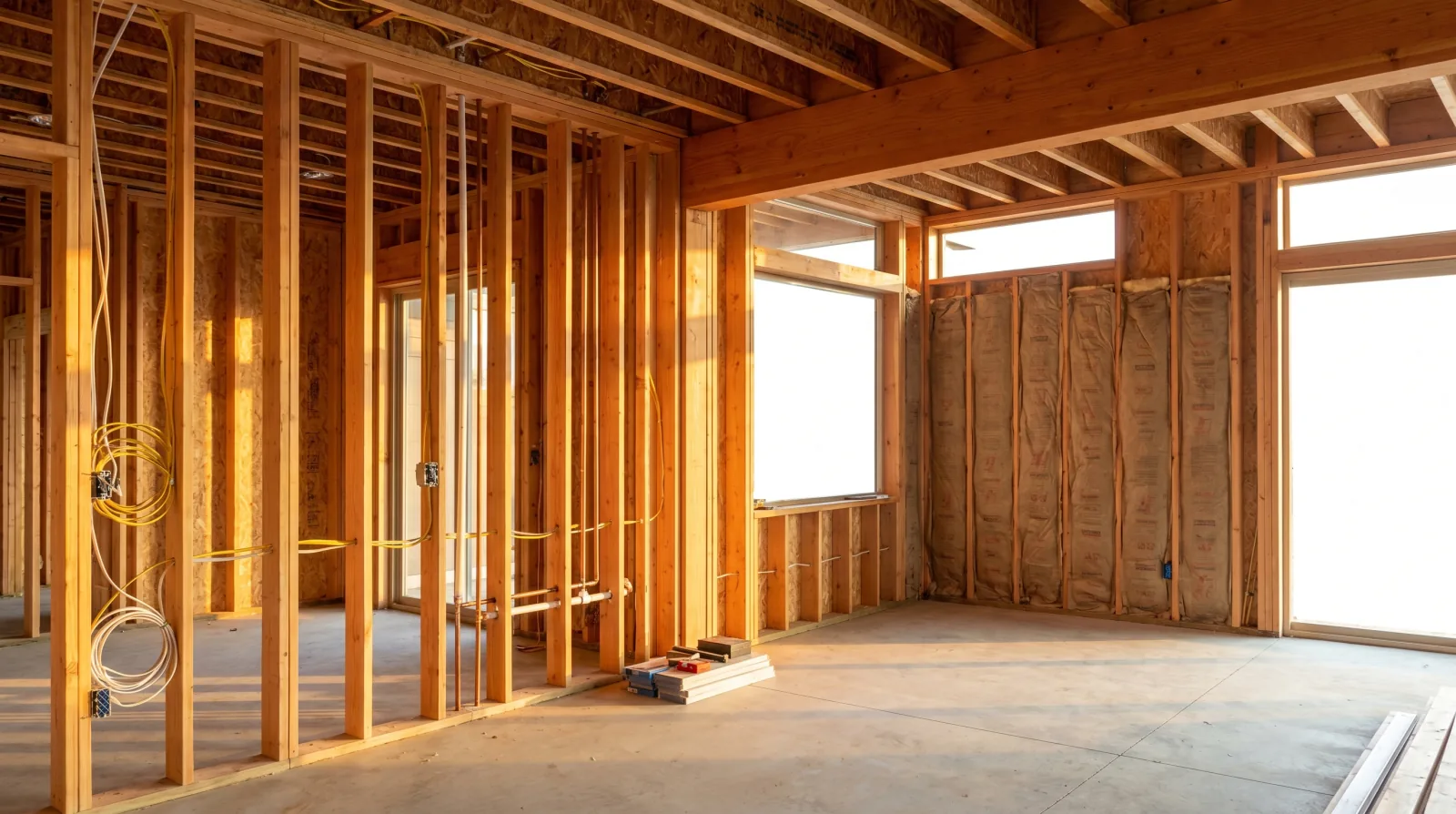
Rough-In Inspection City inspection of framing, plumbing rough-in, and electrical rough-in before insulation and drywall close the walls. The key checkpoint for catching structural or mechanical issues while they're still accessible and correctable without major rework.
Insulation Inspection Municipal inspection confirming insulation placement and vapour barrier installation before drywall proceeds. The energy advisor also checks the airtightness membrane and penetration sealing at this stage on every Step Code project.
Final Inspection / Occupancy Permit The final municipal sign-off confirming the building is complete and compliant with all applicable code requirements. The occupancy permit is required before the home can be legally occupied. The 2-5-10 warranty paperwork is issued at or near this milestone.
These terms cover the majority of what comes up in a Burnaby custom home project from the first zoning analysis to the handover walk. For a quick lookup later, the same terms live on our construction glossary page. If you're early in the process and want to understand what's involved before committing to anything, a planning conversation costs nothing.
Related reading: Custom home process guide · Getting started chapter · Burnaby R1 & SSMUH explained
Frequently asked questions
- What does Floor Space Ratio (FSR) mean for a Burnaby custom home?
- Floor Space Ratio is the maximum amount of floor area a building can have relative to the lot area. A Burnaby lot with a 0.6 FSR allows a home up to 60 percent of the lot area in total floor space. FSR is often the binding constraint on how large a custom home can be, more so than setbacks or lot coverage in many Burnaby neighbourhoods.
- What is the difference between a Development Permit and a Building Permit in BC?
- A Building Permit is the construction approval issued after a municipality reviews drawings for compliance with the BC Building Code, local zoning, and energy requirements, and it's what authorises construction to begin. A Development Permit is required in addition, for certain project types or locations such as character areas or large additions, and involves design review, sometimes neighbour notification, adding weeks to months to the approval timeline.
- What does 'substantial completion' actually mean on a custom home?
- Substantial completion is the point at which a building is sufficiently complete for its intended use, even if minor deficiencies remain, not the moment keys are handed over. In BC, substantial completion triggers the start of deficiency correction periods and affects lien holdback rules under the BC Builders Lien Act, which requires owners to hold back 10 percent of each progress payment for a statutory period.
- What is ACH50 and why does it matter for a BC custom home?
- ACH50, air changes per hour at 50 pascals, is the airtightness metric measured by a blower-door test. Lower numbers mean a tighter house. Burnaby's current minimum, Step 3 of the BC Energy Step Code, requires 2.5 ACH50 or better for a detached single-family home, while Step 5 tightens that to 1.0 and Passive House targets 0.6. The test is run at midpoint, before drywall closes the walls, and again at final completion.
- What is an allowance in a custom home construction contract?
- An allowance is a budgeted dollar amount within a contract for items not yet fully specified, such as tile, fixtures, or appliances. Allowances are placeholders, not final prices, and if the owner's selections exceed the allowance, the difference comes back as a change order. Low allowances are one of the most common sources of budget surprises on custom home projects.
- What's the difference between a Stipulated Price Contract and a Cost-Plus Contract?
- A Stipulated Price Contract is a fixed price covering a fully defined scope, requiring complete construction documents to price accurately since a stipulated price on incomplete documents is essentially a guess. A Cost-Plus Contract has the owner pay actual construction costs plus a management fee, which is more transparent but shifts cost risk to the owner, and suits projects where the scope is still genuinely uncertain at contract time.
- What is a lien holdback and why does it exist in BC construction contracts?
- Under the BC Builders Lien Act, owners are required to hold back 10 percent of each progress payment until a statutory period after substantial completion. This protects subcontractors and suppliers who have lien rights against the property. A properly structured construction contract accounts for this holdback as a standard term, not an afterthought.
- What is a Pre-Construction Services Agreement (PCSA)?
- A Pre-Construction Services Agreement is the contract governing the planning phase of a custom home, design coordination, permit applications, consultant selection, and preliminary budgeting, before a construction contract is issued. It protects both the owner and the builder by documenting scope and expectations at the planning stage, before construction costs are committed to.