
South Slope · Burnaby
Custom Home Builder on Burnaby's South Slope
Burnaby's South Slope falls gently from Imperial Street toward the Fraser River, taking in the Suncrest pocket and the established residential streets above Marine Way. The slope's southern aspect creates a real rain-shadow microclimate, the area sees noticeably more sun and less rain than the North Slope, and the housing stock is substantially original 1960s and 1970s single-family, much of it now in active teardown rotation.
Last reviewed July 2026
At a glance
What we do here.
- South-facing aspect with a real rain-shadow microclimate
- Flat-to-gentle gradient on most lots, straightforward foundations
- River views from southern reach toward Marine Way
- 1960s-70s housing stock in active teardown rotation
Our approach
Building in South Slope.
The microclimate is part of the design brief
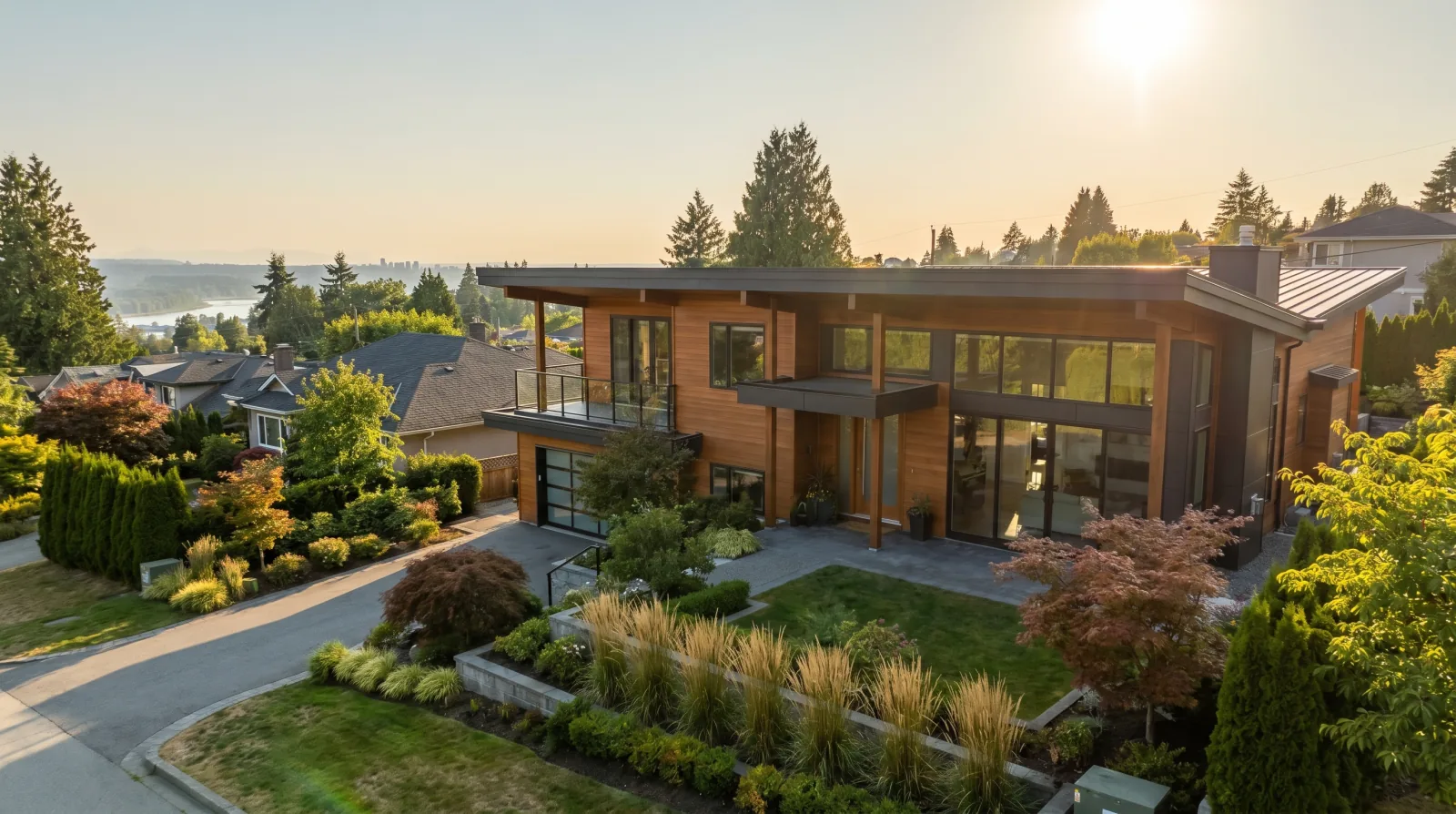
The South Slope sees more direct sun and measurably less rain over the year than the North Slope or the central plateau of Burnaby. That changes the design brief in real ways. South-facing glazing performs differently here, solar heat gain in summer is a more meaningful problem than on north-aspect lots, and shading, glazing specification and overhang depth deserve careful attention. Done well, the same microclimate that creates the heat-gain question makes outdoor living spaces usable for more of the year than almost anywhere else in Burnaby.
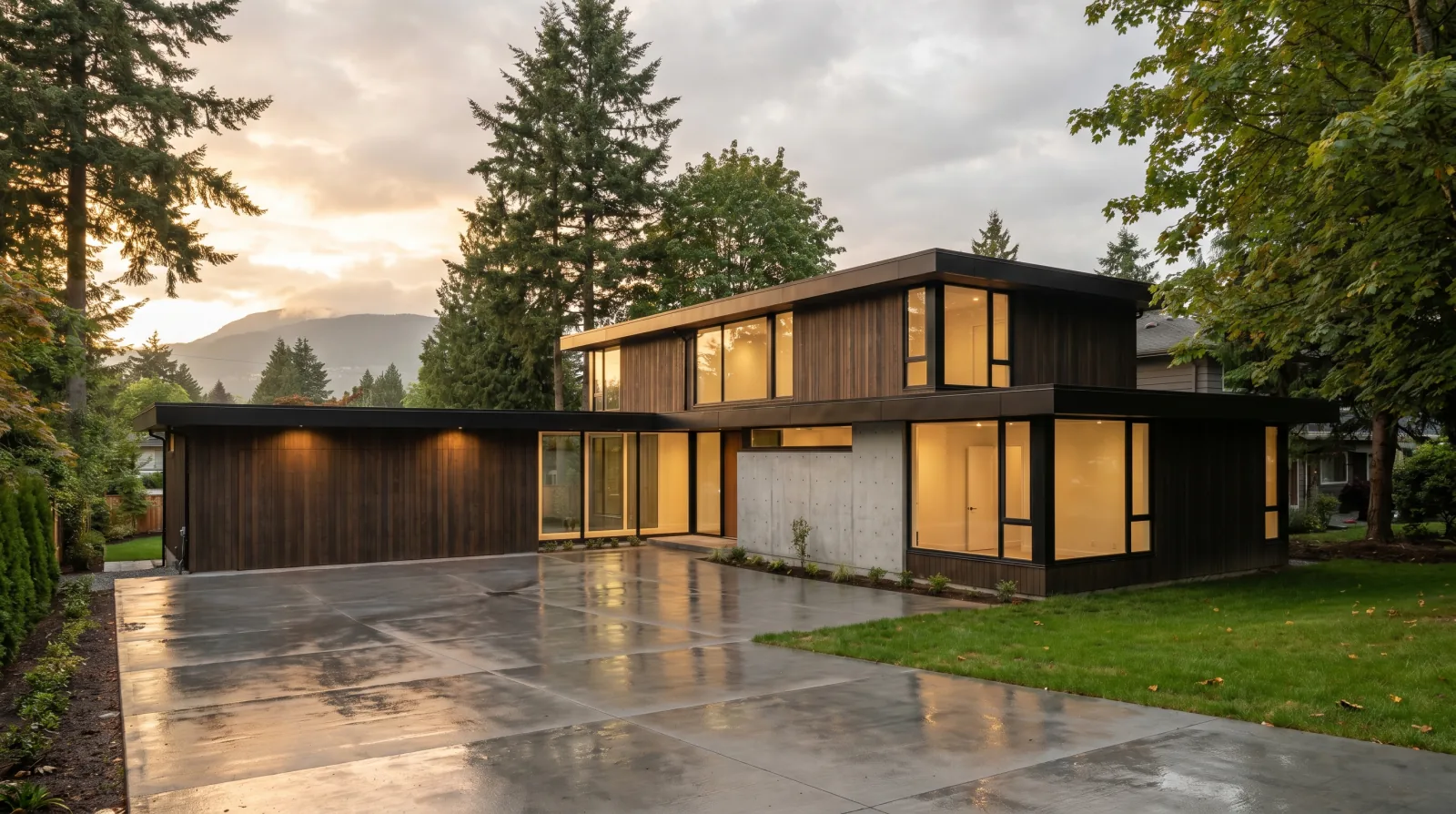
We design South Slope projects around the aspect rather than against it. Deep overhangs on the south elevation, appropriately specified solar heat gain coefficients, and outdoor living spaces oriented to capture the sun in shoulder seasons without baking in July.
The lot stock and what it supports
Most South Slope lots run flat to gently sloped, which keeps foundations and drainage straightforward and lets more of a project's budget flow into envelope and architecture. Frontages and depths vary, the area was built out in waves rather than as a single planned subdivision, but the typical parcel is comparable to other established Burnaby grids. Lots toward the southern edge of the area, closer to Marine Way, sometimes carry views down to the Fraser River and the surrounding industrial and agricultural lands, which can shape orientation and outdoor space planning.
The Suncrest pocket, historically a distinct sub-neighbourhood, is increasingly absorbed into the broader South Slope identity. The lot conditions and housing stock are continuous with the surrounding area, and the teardown and renovation market behaves the same way.
Replacing the 1960s and 1970s housing stock
A defining share of the South Slope's housing was built between the early 1960s and the late 1970s. The original construction quality varies, some homes have foundations and structure that justify a serious renovation, others have aged out, and the renovation-versus-rebuild question is genuinely active here. We've worked through enough South Slope projects to know that the answer depends on the specific lot and the specific structure, not a default in either direction.
When the rebuild path is the right one, the South Slope rewards architecture that takes the aspect seriously. South-facing primary living spaces, generous outdoor terraces, glazing that captures the sun without overheating in summer. The microclimate is a genuine design opportunity, and we treat it as one.
Tree-bylaw and grading realities
Burnaby's tree bylaw applies on the South Slope as it does elsewhere in the city, any tree 20 cm or larger in diameter on a lot under development is protected, and an arborist report is part of every permit application. The South Slope tends to carry less continuous canopy than wooded neighbourhoods like Buckingham Heights or Deer Lake, but most lots still have meaningful trees that have to be reconciled with the design from the start. We do that at feasibility, not at permit submission.
Common Questions
Before we begin in South Slope.
Is the rain-shadow effect on the South Slope significant enough to design around?+
Yes. The aspect creates real differences in solar exposure and precipitation compared to north-aspect Burnaby neighbourhoods. We design South Slope projects with appropriate solar heat gain coefficients, shading and overhang depth on south elevations, and we orient outdoor spaces to take advantage of the longer usable shoulder seasons.
Are South Slope lots typically straightforward to build on?+
Foundation-wise, yes, most lots are flat to gently sloped, which keeps structural and drainage scope straightforward. The design opportunity tends to be in the envelope and the orientation, not in resolving complex hillside foundation conditions.
Is the existing housing stock typically a renovation or a rebuild?+
It varies. The 1960s and 1970s housing cohort that defines much of the South Slope has aged unevenly, some homes are well-maintained renovation candidates, others have run out of useful life. We do a site walk before recommending a path and give a direct answer.
How many units can I build on a typical South Slope lot under R1 SSMUH?+
Most South Slope lots are 40- to 60-foot frontages on the established residential grid. Provincial SSMUH legislation permits up to four units on lots in this size range, and the up-to-six-unit threshold applies to parcels within 400 metres of a frequent-transit stop. The Royal Oak SkyTrain station anchors a walking-distance area that captures parts of the western reach of the South Slope. The flat-to-gentle grade keeps the parking and drainage math straightforward, which makes South Slope a more practical multiplex location than the hillside neighbourhoods.
What's the typical permit timeline for a South Slope custom home?+
Most South Slope custom-home permits run roughly 8 to 12 months from design submission to issuance, on the shorter end of the central-Burnaby range. The flat grade, predictable drainage and conventional lot conditions keep the file moving. Construction typically runs another 12 to 16 months. Files that include SSMUH multiplex configurations or significant tree retention can stretch the schedule, and Royal-Oak-adjacent transit-oriented density questions add layers to the review on a small share of lots.
How does the South Slope compare to the North Slope for a custom build?+
The aspect is the headline difference. The North Slope, Capitol Hill, Burnaby Heights, Westridge, faces north toward Burrard Inlet with view-driven design briefs and the steeper grades that come with that. The South Slope faces south toward the Fraser, with a measurably sunnier and drier microclimate and mostly flat-to-gently-sloped lots. Foundations and structural scope are simpler on the South Slope; the design opportunity sits in the envelope and the orientation rather than in resolving complex hillside conditions. For straightforward custom-home economics with a sunny aspect, the South Slope. For inlet views with serious architecture, the North Slope.
What views are available from South Slope lots near Marine Way?+
The southern reach of the South Slope, closer to Marine Way, sometimes offers views down toward the Fraser River and the surrounding industrial and agricultural lands. This isn't a defining feature of most South Slope lots the way inlet views are on the North Slope, but on the right parcel it's a real design consideration that shapes orientation and outdoor space planning. We assess view potential as part of every site visit rather than assuming it based on the general area.
Does the Suncrest pocket have different rules from the rest of South Slope?+
No. Suncrest was historically a distinct sub-neighbourhood name, but its lot conditions and housing stock today are continuous with the surrounding South Slope area, and the same zoning, tree bylaw, and permitting process apply. We treat feasibility on a Suncrest lot the same way we would anywhere else on the South Slope, evaluated on the specific parcel rather than an assumption tied to the older sub-neighbourhood name.
From the Journal
Further reading on South Slope.
Begin
Plan your project in South Slope.
A short conversation is the fastest way to understand what's possible on your lot, feasibility, schedule, scope, the lot conditions you should be thinking about.