
Parkcrest · Burnaby
Custom Home Builder in Parkcrest, Burnaby
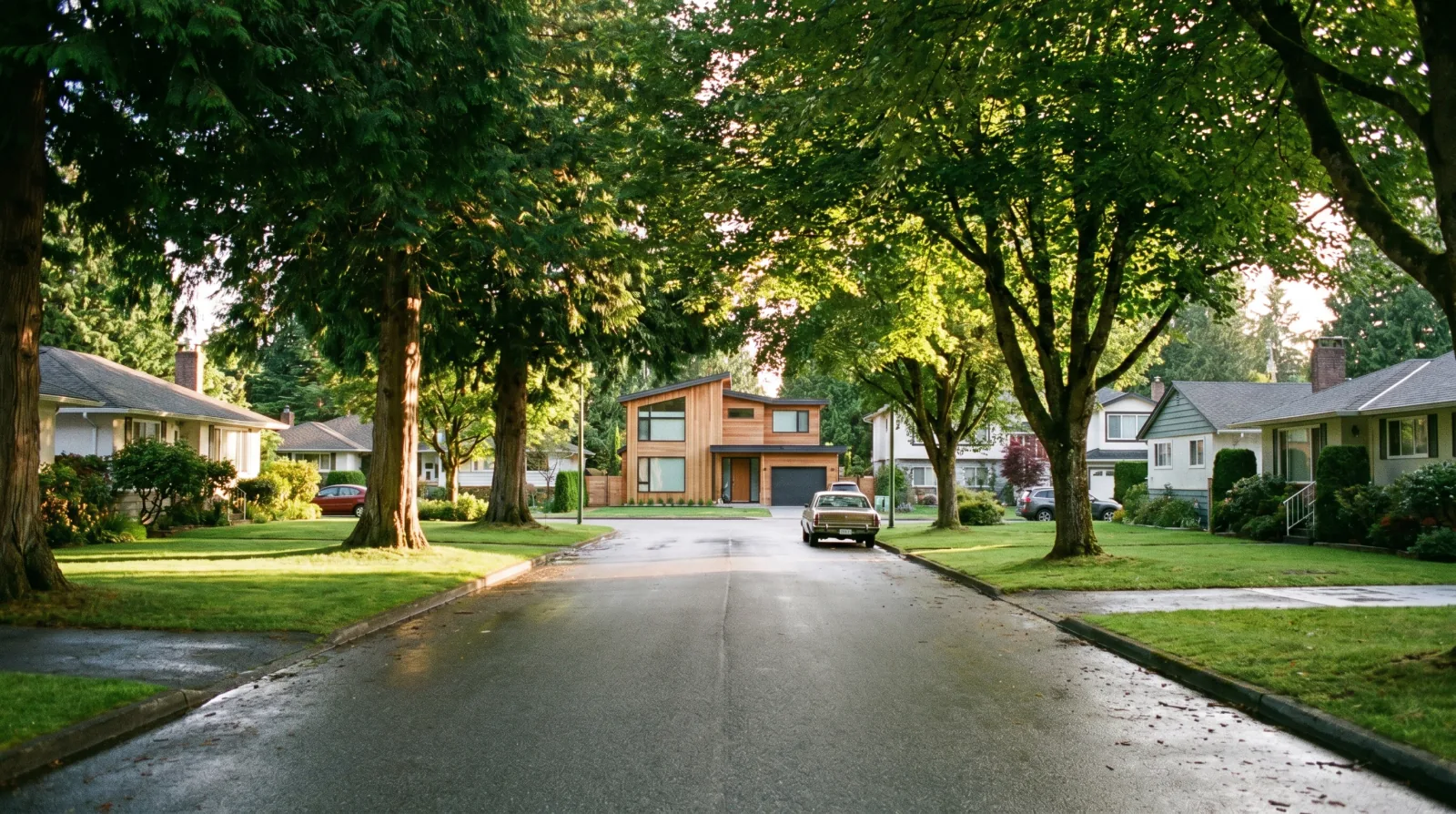
Parkcrest sits north of Lougheed Highway and east of Sperling, a quiet grid of post-war ranchers on flat 60- to 66-foot lots. The streets, Sprott, Halifax, Curtis, Parker, run under a mature canopy of cedar and maple that has shaped the neighbourhood's character for half a century. It's also what makes a Parkcrest teardown a more involved exercise than the lot dimensions would suggest.
Last reviewed July 2026
At a glance
What we do here.
- Flat 60 to 66 ft single-family lots on a regular grid north of Lougheed
- Original 1950s-60s rancher housing stock in active teardown rotation
- Mature street-tree canopy along Sprott, Halifax and Curtis
- Tree-bylaw-driven design from feasibility, not after permit submission
Our approach
Building in Parkcrest.
The lot stock and what it supports
Parkcrest was built out predominantly in the 1950s and 1960s as a planned single-family neighbourhood, and the lot pattern reflects that, regular rectangular parcels, mostly 60 to 66 feet wide with depths around 120 feet. The grade is gentle to flat across most of the area, which keeps foundations and drainage straightforward and lets more of a project's budget flow into the architecture, envelope and systems that owners actually live with.
What the original developer planted is now sixty to seventy years old. Mature Douglas fir, western red cedar, big-leaf maple and a number of significant deciduous specimens line the streets and the rear yard lines. Burnaby's tree bylaw, which protects trees 20 cm in diameter or larger on any lot under a development application, turns this canopy into a hard design constraint on every Parkcrest teardown.
Designing around the canopy
We start every Parkcrest project with an arborist walk and a tree inventory. The City of Burnaby will read the inventory carefully at permit submission, and designs that ignore retention requirements get redrawn. The right approach is the opposite: let the trees that have to stay shape the building envelope from the first sketch, so the design and the canopy are reconciled before drawings are committed.
The reward for doing this well is a home that arrives on a street that already feels like a neighbourhood. Parkcrest's appeal is largely the canopy, and a thoughtful new home that keeps the significant trees feels right on the block in a way that an aggressive clear-cut never does. It also tends to track better through Burnaby's design review.
Replacing a 1950s rancher
The original Parkcrest housing stock, modest single-storey ranchers, often around 1,200 to 1,800 square feet, has aged unevenly. Some are well-maintained and structurally sound; many have undersized footings, knob-and-tube electrical, asbestos-era materials and envelopes that are simply done. For owners on these lots, the renovation-versus-rebuild conversation is real, and the answer usually depends on the foundation and the lot's relationship to the adjacent street trees.
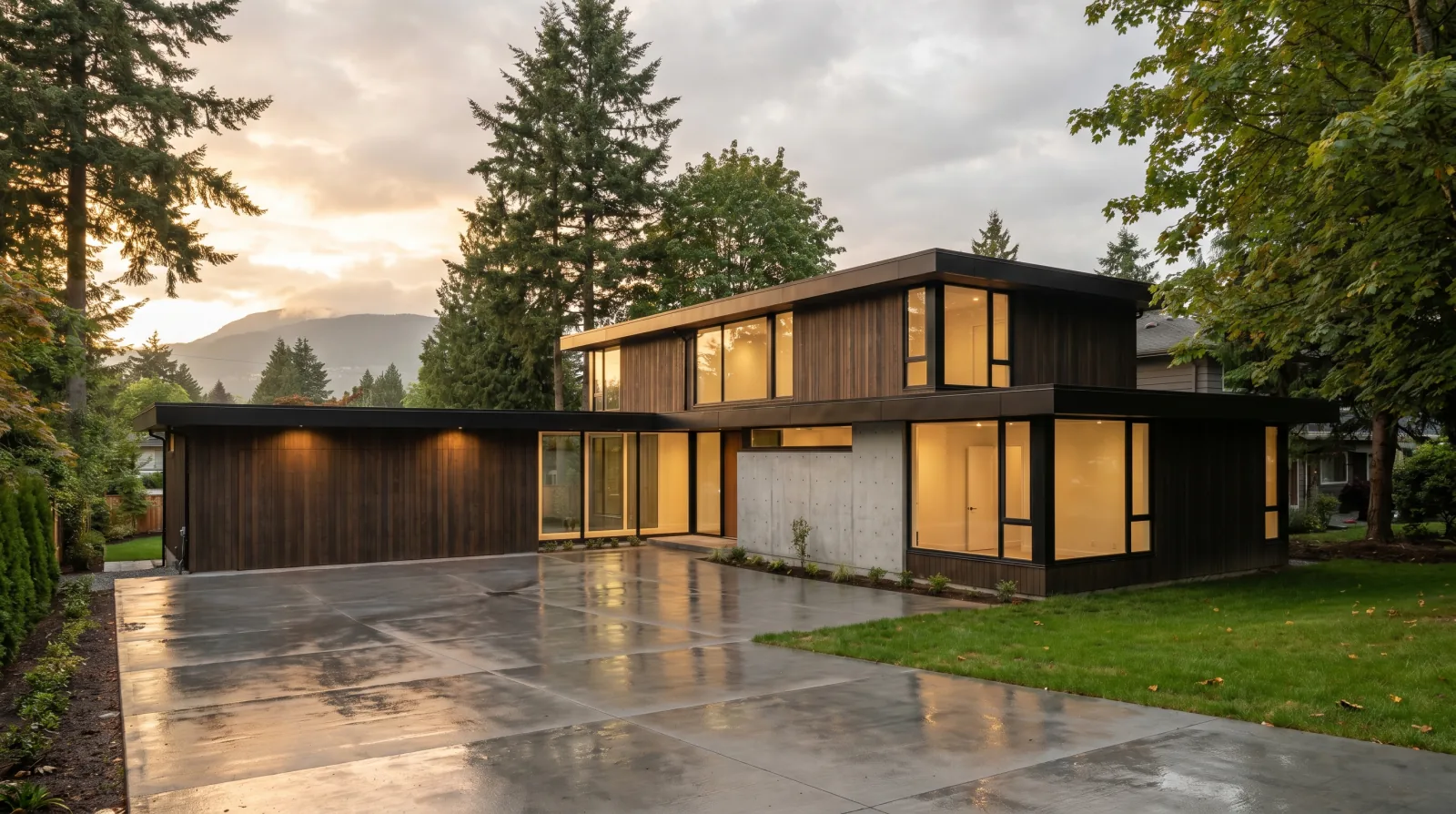
When the rebuild path is the right one, a Parkcrest custom home tends to read modern but restrained. The neighbourhood doesn't reward statement architecture, and the canopy makes sweeping rooflines and aggressive massing harder to fit comfortably. The houses that work here are scaled to the street, generous in plan, and detailed for the rain.
Renovations and additions where the bones justify it
A meaningful share of Parkcrest's ranchers are worth renovating rather than tearing down. Where the foundation is sound and the structure has been kept dry, a deep renovation paired with a sensitively scaled addition can deliver most of the experience of a new home while keeping the relationship to the canopy and the street that already exists. We're selective about which projects qualify and direct about the ones that don't.
Common Questions
Before we begin in Parkcrest.
How does the tree bylaw actually affect a Parkcrest teardown?+
Burnaby's tree bylaw protects any tree 20 cm or larger in diameter on a lot under development application. On Parkcrest's 60-foot lots with a 60-year canopy, that often means three to six protected trees on a single parcel. An arborist report is required at permit submission, and retention conditions are written into the building permit. We bring the arborist in at feasibility so the design accommodates the canopy from the start.
Do Parkcrest lots qualify for the same density as transit-adjacent neighbourhoods?+
Parkcrest sits north of the main Lougheed transit corridor and outside the walking-distance radius of the Lougheed Town Centre and Brentwood SkyTrain stations, so the City's transit-oriented density bonuses don't generally apply here. The neighbourhood's character remains firmly single-family, with standard SSMUH up-to-four-unit rules rather than the up-to-six-unit transit-area threshold.
Is the original housing stock typically worth renovating?+
Sometimes yes, often not. The 1950s and 1960s ranchers vary considerably in how they've been maintained. Foundation condition, drainage history and the state of the original framing are the three things we look at before recommending a path. We give a direct answer after a site walk.
How many units can I build on a typical Parkcrest lot under R1 SSMUH?+
Parkcrest's regular 60- to 66-foot lots are larger than the typical Burnaby SSMUH target, which means up to four units is comfortably permitted under provincial rules and the lot dimensions actually support sensible multiplex configurations. Parkcrest is not within the 400-metre frequent-transit bonus area for the Lougheed corridor SkyTrain stations in most of the area, so the up-to-six-unit threshold doesn't generally apply. The flat grade keeps parking and drainage straightforward, which makes Parkcrest one of the more practical SSMUH locations in north Burnaby.
What's the typical permit timeline for a custom home in Parkcrest?+
Most Parkcrest custom-home permits run roughly 9 to 13 months from design submission to issuance. The flat grade keeps the foundation and drainage review predictable, but the canopy adds detail to the tree-bylaw review and can stretch the file. Construction typically runs another 12 to 16 months. Multiplex projects on these larger lots run longer because the density and parking review adds layers. We map the windows into the schedule from week one and keep the arborist involved through construction.
How does Parkcrest compare to Sullivan Heights for a custom build?+
Both are flat suburban grids north of Lougheed with broadly similar lot sizes and mid-century housing stock. Parkcrest sits west of Sperling, closer to Brentwood and the eastern edge of the Lougheed corridor amenity. Sullivan Heights sits further east, closer to Cameron, Lougheed Town Centre and the climb to SFU. The streetscapes feel similar, quiet, established, leafy, but Sullivan Heights' housing is generally a decade newer (1970s-80s versus Parkcrest's 1950s-60s) and the original construction is sometimes more solid. For renovation candidates, Sullivan Heights edges it. For larger lots and an older canopy, Parkcrest.
What size is the typical rancher being replaced in Parkcrest?+
Original Parkcrest ranchers typically run 1,200 to 1,800 square feet, single-storey homes on lots generous enough to support a considerably larger replacement home. Some are well-maintained with sound foundations; many have undersized footings, knob-and-tube electrical, and asbestos-era materials that push the renovation-versus-rebuild decision toward a rebuild. We assess this on-site rather than assuming based on the era alone.
Does new construction in Parkcrest need to match the neighbourhood's architectural style?+
There's no formal design-matching requirement, but the neighbourhood's mature canopy and modest scale generally reward restraint over statement architecture. Sweeping rooflines and aggressive massing tend to sit awkwardly against Parkcrest's established streetscape and the retained trees a design has to work around. The homes that fit best are scaled to the street, generous in plan, and detailed for the coastal climate rather than designed to stand out.
From the Journal
Further reading on Parkcrest.
Begin
Plan your project in Parkcrest.
A short conversation is the fastest way to understand what's possible on your lot, feasibility, schedule, scope, the lot conditions you should be thinking about.