
Westridge · Burnaby
Custom Home Builder in Westridge, Burnaby
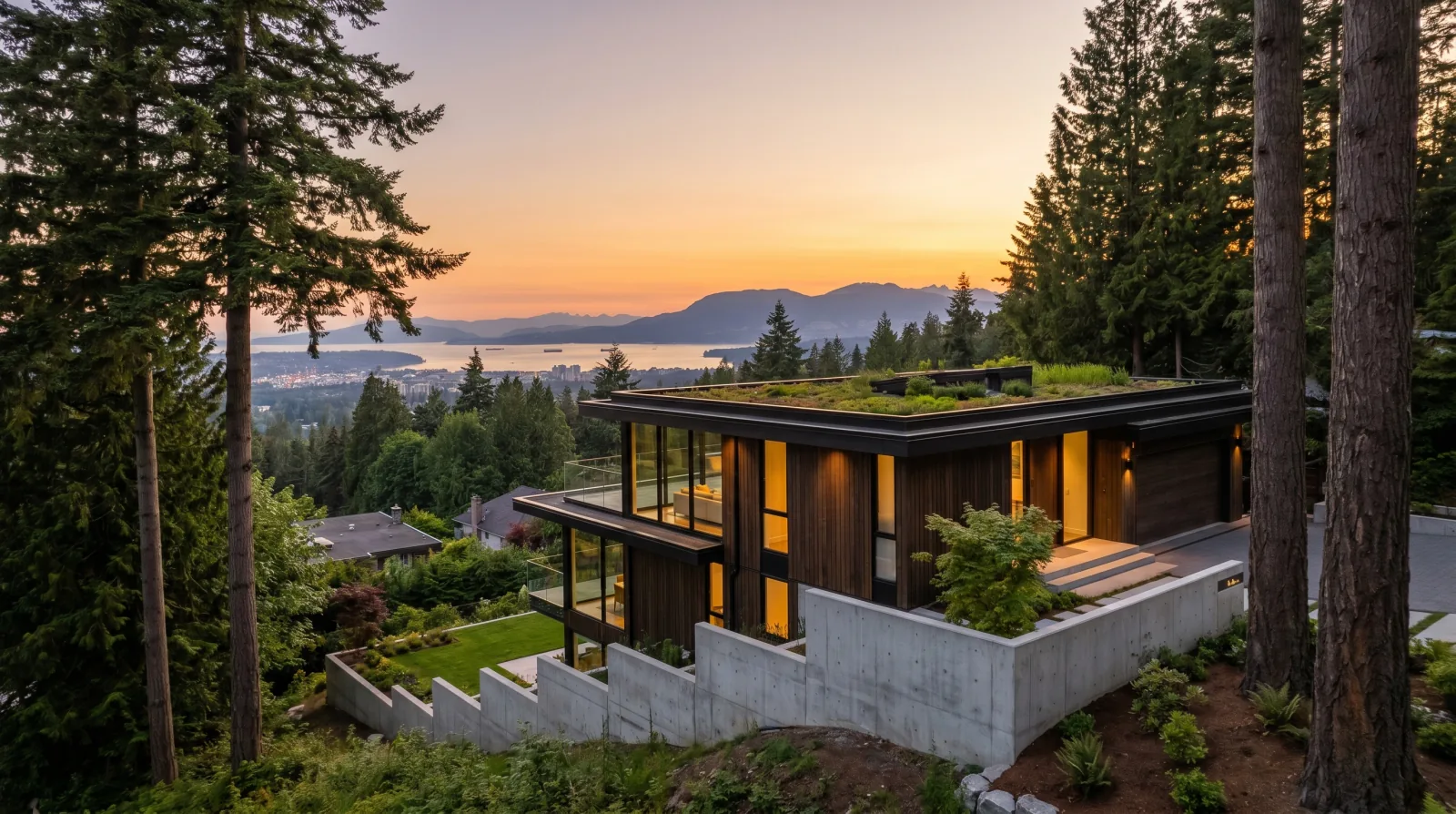
Westridge sits on the steep, south-facing flank above Burrard Inlet, east of Capitol Hill and just west of the Burnaby-Port Moody boundary. The aspect is the headline, broad inlet and Indian Arm views from almost every lot, but the slope, the proximity to industrial neighbours along the inlet shoreline, and the patchwork of view-protection covenants on certain streets make this one of the most demanding pockets in the city to build well.
Last reviewed July 2026
At a glance
What we do here.
- South-facing inlet-view lots on the slope east of Capitol Hill
- Geotechnical-led design on grades that often exceed 20 percent
- Air-quality-aware envelope detailing given proximity to inlet industrial neighbours
- Renovations on 1960s-80s view homes where the lot still drives the value
Our approach
Building in Westridge.
The slope is the project
Most Westridge lots fall meaningfully from street to rear, and a number of them sit on grades steep enough to trigger a geotechnical report from the City of Burnaby before a permit will be issued. Streets like Bayview, Cliff Avenue and parts of Westridge Avenue itself carry the kind of slope where shoring, tieback retention and structured drainage become baseline scope rather than premium upgrades. We treat the geotech and the survey as the lead documents on a Westridge project, the architecture is shaped to what the slope will accept, not the other way around.
Drainage outlet is the second question we ask after slope. Lots high on the hill sometimes have to discharge through neighbours' systems or to engineered points further downhill, and the City's drainage review on this slope is detailed. We sort that out at feasibility, before any architectural commitment.
Envelope detailing for an inlet-facing site
Westridge faces south across Burrard Inlet, which is both the appeal and the source of the harder envelope-detailing problems. Strong south sun on the upper slopes means glazing specifications and shading have to be thought through carefully, west-coast modern with floor-to-ceiling south glass looks beautiful in the renderings and overheats in real summers. We design with appropriate solar heat gain coefficients, deep overhangs and shading where it earns its keep.
The proximity of refinery and terminal operations along the inlet shoreline is also part of the brief here. Mechanical ventilation specifications, particularly fresh-air intake siting and filtration on the HRV, deserve more attention on a Westridge build than they would in inland Burnaby. It's not exotic work, but it's correct work, and we do it as standard.
View covenants and overlook
Some Westridge streets carry historical view-protection arrangements between neighbours, informal in places, registered against title in others. Before we commit to a roof line or upper-floor envelope on a Westridge project, we read the title and check what the block has actually agreed to. The wrong assumption about ridge height or the wrong window placement on a side elevation can cost the design six months and a re-submission.
Privacy detailing matters in both directions on this slope. Lots stack vertically more than they do on flat Burnaby blocks, and what you can see of the inlet, the next neighbour up the hill can usually see of your roof deck. We design that out from the start.
Renovations on the existing view stock
A lot of the homes on Westridge are 1960s, 1970s and 1980s view-era builds, split-levels and side-split executive homes whose foundations followed the original grade and whose layouts no longer match how owners want to live. Where the foundation is sound and at the right elevation, a deep renovation paired with envelope and mechanical replacement can unlock most of the lot's value without restarting the geotechnical and drainage clock from scratch. Where the foundation is compromised, and on this slope it sometimes is, a teardown is the more disciplined path. We walk through that honestly.
Common Questions
Before we begin in Westridge.
Will my Westridge lot need a geotechnical report?+
Most Westridge lots steep enough to qualify will. The City of Burnaby uses a slope threshold to trigger geotechnical review, and a meaningful share of Westridge parcels sit above it. We run a preliminary slope assessment as part of feasibility so you know whether geotech is required before you commit to a design path.
Are the inlet views on my lot legally protected?+
It depends on the street and the title. Some Westridge blocks have view covenants registered against title; others rely on informal neighbour arrangements; many have neither. We do a title search at feasibility and read what the block has actually agreed to before we draw a roof line.
Does proximity to refinery operations affect what I should build?+
It affects how you build, more than what you build. Mechanical ventilation, fresh-air intake siting, and HRV filtration deserve more attention here than on inland lots. None of it is exotic, it's correct envelope and mechanical detailing for a near-industrial site, and we incorporate it as standard.
Can I build a multiplex on a Westridge lot?+
Provincial SSMUH legislation permits up to four units on most Burnaby single-family lots, including Westridge in principle. In practice, the slope, the parking realities and the geotechnical scope on these lots make the multiplex math harder to pencil than on flat-grade neighbourhoods. Steep parcels sometimes work for a duplex with a coach house better than a full fourplex. Westridge is not within the 400-metre frequent-transit bonus area for any SkyTrain station, so the up-to-six-unit threshold doesn't apply. We run feasibility honestly before any design commitment.
What's the typical permit timeline for a Westridge custom home?+
Westridge permits run longer than flat-grade Burnaby permits because the geotechnical, drainage and view-protection layers add detail to the file. Most Westridge custom-home permits run roughly 11 to 15 months from design submission to issuance. The construction phase that follows typically runs another 16 to 20 months because the foundation, retention and envelope work is more involved. Files that include view-covenant questions or that require significant tree retention can stretch the schedule further. We build that timeline into the schedule from week one.
How does Westridge compare to Capitol Hill for a hillside custom build?+
Both sit on steep slopes above Burrard Inlet with similar geotechnical and drainage demands, but they face different directions. Capitol Hill faces north across the inlet to the North Shore mountains. Westridge faces south, with Indian Arm to the east and the inlet's industrial shoreline directly below. The view orientations drive different design briefs, south-facing glazing and shading concerns matter more on Westridge, while Capitol Hill projects deal less with solar heat gain but more with wind exposure. Westridge also brings the air-quality and acoustic considerations that proximity to refinery operations imposes.
What slope grades are typical on Westridge lots?+
Many Westridge lots exceed 20 percent grade, particularly along streets like Bayview, Cliff Avenue, and parts of Westridge Avenue itself. At that grade, shoring, tieback retention, and structured drainage become baseline scope rather than optional upgrades. We treat the survey and geotechnical report as the lead documents on a Westridge project, shaping the architecture to what the slope will accept rather than fitting the slope to a predetermined design.
How does drainage discharge work on a steep Westridge lot?+
Lots high on the Westridge slope sometimes need to discharge stormwater through neighbouring properties' systems or to engineered points further downhill, since gravity drainage to the street isn't always straightforward on this grade. The City's drainage review on this slope is detailed and site-specific. We work this out at the feasibility stage, before any architectural commitment, since the drainage solution can affect where the foundation and retaining walls can sit.
From the Journal
Further reading on Westridge.
Begin
Plan your project in Westridge.
A short conversation is the fastest way to understand what's possible on your lot, feasibility, schedule, scope, the lot conditions you should be thinking about.